Post-consumer recycled (PCR) plastic is becoming an increasingly important material in cosmetic packaging. As beauty brands work toward more sustainable packaging strategies and prepare for evolving regulations, recycled content is no longer just an environmental consideration. It is also a material engineering decision.
However, introducing PCR into cosmetic packaging is not as simple as replacing virgin plastic with recycled resin.
The recycled content percentage can influence the appearance, transparency, colour consistency, mechanical properties and processing behaviour of the finished package. These differences matter particularly in beauty products, where packaging aesthetics and product protection are both essential.
For manufacturers and beauty brands, the challenge is finding the right balance between recycled content, visual expectations and reliable production performance.
This guide explains how PCR affects cosmetic packaging and what brands should evaluate before selecting a recycled material solution.
1. What Is PCR Cosmetic Packaging?
PCR stands for Post-Consumer Recycled material. It refers to plastic recovered after consumers have used and discarded products, which is then collected, sorted, cleaned and reprocessed into recycled resin for new applications.
For cosmetic packaging, PCR can be incorporated into different components, depending on the material grade, application and technical requirements.
Common examples include:
- Skincare bottles and jars
- Lotion and serum containers
- Cosmetic caps and closures
- Lip gloss and lipstick packaging
- Compact cases
- Outer packaging components
PCR should be distinguished from post-industrial recycled (PIR) material.
PIR generally comes from manufacturing waste generated during industrial production, while PCR originates from products that have completed their consumer use.
This distinction is particularly important under the EU Packaging and Packaging Waste Regulation (PPWR), which specifies post-consumer recycled content requirements for certain plastic packaging categories.
For brands developing sustainable packaging, understanding the source and traceability of recycled resin is therefore just as important as knowing its percentage.
2. How Does PCR Content Affect Packaging Color?
Color is often the first visible difference when switching from virgin plastic to PCR.
Unlike virgin resin, which can offer a relatively predictable starting colour, recycled resin may contain variations originating from its previous material sources, sorting processes and recycling history.
Depending on the resin and recycling quality, PCR may introduce:
- Slight yellow, grey or brown undertones
- Reduced colour brightness
- Small visible particles or specks
- Greater batch-to-batch variation
- Differences in surface appearance
These characteristics can become more noticeable when the recycled content percentage increases.
For beauty brands with strict brand-colour requirements, maintaining consistency across multiple packaging components can therefore require additional material selection and colour adjustment.
Can PCR Plastic Match a Brand’s Pantone Color?
Yes, but the result depends on the PCR grade, base colour, recycled content percentage and selected pigment system.
For example, a pale pink or transparent packaging design may be more difficult to reproduce consistently using recycled resin than a dark or opaque colour.
Manufacturers can explore several approaches:
Adjusting the PCR percentage: A lower recycled content percentage may help maintain a closer visual appearance to virgin plastic.
Selecting suitable pigments: Carefully selected masterbatches can compensate for some underlying colour variations.
Choosing darker colours: Deep colours, black, grey and earth tones can help create a more consistent visual appearance when the recycled base material has natural colour variations.
Approving physical samples: Final colour approval should be based on actual moulded components rather than resin pellets or digital colour references alone.
For more information, see our guide to Cosmetic Packaging Color Matching Across Plastic, Glass and Metal.
3. How Does PCR Affect Transparency and Clarity?
Transparency is another important consideration, especially for skincare bottles, serum containers and clear cosmetic packaging.
Virgin PET and other suitable virgin resins can provide high clarity when the material and manufacturing process are properly controlled.
PCR materials may behave differently.
Depending on the recycling process and resin quality, recycled plastic can have:
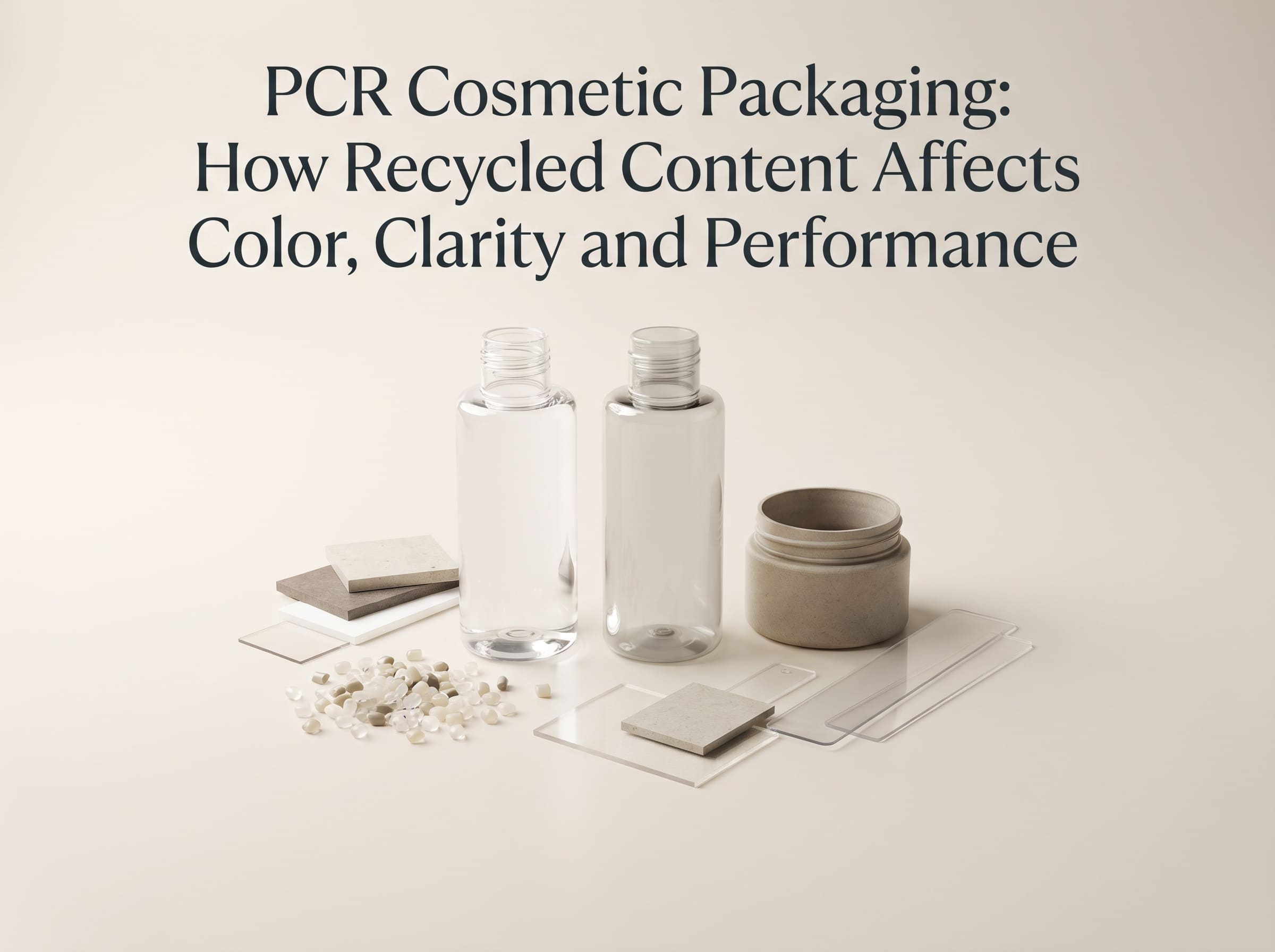
- Slight haze
- Reduced light transmission
- A subtle colour tint
- Visible recycled texture
- Less consistent transparency between batches
This does not mean all PCR packaging must look cloudy or opaque.
The final result depends on the original material source, sorting quality, resin processing and recycled content percentage.
For brands that require a clear, premium appearance, a lower PCR percentage or a carefully selected high-quality recycled resin may be more appropriate.
For brands that prefer a visible sustainability aesthetic, slight colour variations and recycled textures can instead become part of the design language.
The key is to establish the acceptable visual standard before production.
4. Understanding Different PCR Content Levels
There is no universal PCR percentage that works best for every cosmetic packaging project.
A practical starting point is to compare different recycled content levels against the brand’s appearance and performance requirements.
Her Beauty’s current Sustainable Eco portfolio presents three PCR development directions:
| PCR Content | Typical Appearance | Suitable Design Direction |
|---|---|---|
| 30% PCR | Higher transparency, closer to virgin appearance | Clear or lighter-coloured packaging |
| 50% PCR | Slight tint or more visible material characteristics | Coloured and opaque packaging |
| 100% PCR | More visible recycled texture and limited colour flexibility | Black, grey and earth-tone designs |
These are indicative development directions rather than universal performance guarantees. Actual results depend on resin type, source, colour and packaging structure.
For brands developing a new sustainable packaging range, comparing several PCR percentages through physical samples is often more effective than selecting a percentage based on marketing objectives alone.
Explore our Sustainable Cosmetic Packaging Solutions and PCR Packaging Matrix.
5. How Does PCR Affect Mechanical Performance?
Appearance is only one part of the evaluation.
PCR can also influence the physical properties and processing behaviour of plastic packaging.
Recycled resin may have different melt-flow characteristics, material consistency and mechanical performance compared with virgin resin.
Potential areas requiring attention include:
Impact Resistance
Some PCR grades may show reduced impact performance, depending on their material history and quality. This can influence drop resistance and the durability of bottles, caps and compact cases.
Dimensional Stability
Variations in recycled resin can affect moulding behaviour, shrinkage and component dimensions. This is particularly important for packaging with tight assembly tolerances.
Stress Cracking
Certain components, especially snap-fit structures and living hinges, may require additional evaluation when introducing PCR.
Processing Stability
Different melt-flow characteristics can influence injection pressure, filling behaviour, cooling conditions and production consistency.
Odour
Some recycled materials may retain odours from their previous use or recycling process. Material selection and quality control are therefore important, particularly for packaging containing fragrance-sensitive formulas.
These challenges do not make PCR unsuitable for cosmetic packaging. They simply mean that material selection and production parameters should be evaluated together.
For a technical overview of PCR in plastic packaging closures, see Avient’s guide to using post-consumer recycled content.
6. Does PCR Affect Printing and Surface Decoration?
Cosmetic packaging often relies on decoration to communicate brand identity.
Silk-screen printing, hot stamping, spray coating, UV finishing and metallization can all influence the final appearance of a package.
When PCR is introduced, the substrate may have different colour characteristics, surface conditions or processing behaviour.
This can affect:
- Printed colour consistency
- Coating appearance
- Surface adhesion
- Metallic finish uniformity
- Final gloss and visual texture
For example, a transparent package made with virgin resin may produce a different visual result from the same design made with PCR.
A coating or opaque decoration may help manage some appearance differences, but it does not automatically resolve every material or adhesion issue.
The recommended approach is to validate the complete decorated component using the actual recycled resin before approving mass production.
7. What Does PPWR Mean for PCR Cosmetic Packaging?
The EU Packaging and Packaging Waste Regulation (PPWR), Regulation (EU) 2025/40, introduces requirements covering packaging recyclability, recycled content, minimisation, reuse and labelling.
The regulation generally applies from 12 August 2026, while minimum recycled-content requirements for certain plastic packaging categories are scheduled to begin in 2030.
Under Article 7, the 2030 minimum recycled-content benchmarks include:
- 30% for contact-sensitive packaging made mainly from PET, excluding single-use beverage bottles
- 10% for contact-sensitive plastic packaging made from materials other than PET, excluding single-use beverage bottles
- 35% for other plastic packaging
Higher targets are scheduled for 2040.
Importantly, these requirements are category-specific. Brands should not assume that every cosmetic bottle, cap, jar or applicator has the same recycled-content target. Applicable exemptions, packaging classification and calculation rules must also be considered.
The regulation specifies recycled content recovered from post-consumer plastic waste. Factory production scrap should not automatically be counted as qualifying PCR.
For brands selling in Europe, this makes material documentation, recycled-content verification and supplier transparency increasingly important.
Her Beauty has already addressed the broader regulatory requirements in our PPWR and Cosmetic Packaging Guide.
For the complete legal requirements, consult the EU Packaging and Packaging Waste Regulation (EU) 2025/40.
8. What Should Brands Test Before Mass Production?
Before approving PCR cosmetic packaging, brands should evaluate both the incoming material and the finished package.
A practical development process includes:
1. Material Verification
Confirm the polymer type, PCR percentage, material source and relevant supporting documentation.
2. Colour and Appearance Evaluation
Produce moulded samples and compare transparency, colour, surface texture and visible particles against the approved reference.
3. Mechanical Testing
Evaluate relevant properties such as impact resistance, closure fit, hinge durability and dimensional stability.
4. Formula Compatibility
Test the actual formula with the final PCR packaging structure. Switching from virgin resin to PCR can change the material’s behaviour, so previous compatibility results should not automatically be assumed to remain valid.
5. Decoration Validation
Check printing adhesion, coating appearance, hot stamping and other finishing processes on representative PCR components.
6. Production Consistency
Evaluate samples from representative production conditions and establish acceptable material and appearance tolerances.
For a more detailed testing framework, read our Cosmetic Packaging Compatibility Testing Guide.
The Canada Plastics Pact PCR Integration Guide also provides useful guidance on PCR sourcing, quality assurance and packaging development.
9. How to Choose the Right PCR Packaging Solution
The best PCR solution depends on the product, brand positioning and target market.
Before selecting a material, consider the following questions:
- Does the package need to remain transparent?
- Is exact brand-colour matching essential?
- What PCR percentage is required?
- Does the structure contain hinges, snap fits or other stress-sensitive features?
- Will the package require printing, coating or metallization?
- Does the finished package need to meet specific PPWR requirements?
- Can the material and recycled-content claims be properly documented?
For some projects, 30% PCR may offer a practical balance between appearance and recycled content.
For others, 50% or 100% PCR may be more appropriate when the brand accepts a more distinctive recycled-material appearance.
There is no single solution for every packaging format.
Material selection should always be based on the finished product’s technical and visual requirements.
Frequently Asked Questions
Is 100% PCR suitable for cosmetic packaging?
Yes, depending on the polymer, resin quality, package structure and intended application. However, colour flexibility, transparency and mechanical performance may require additional evaluation.
Does PCR plastic always look darker than virgin plastic?
No. The result depends on the recycled resin source, processing quality, material percentage and pigment system. Some PCR grades can achieve relatively consistent colours.
Can PCR cosmetic bottles be transparent?
Certain PCR grades can provide relatively high transparency, although clarity may differ from virgin resin. Actual moulded samples should be evaluated before approval.
Is PCR the same as biodegradable plastic?
No. PCR is recycled material recovered from previous products. Biodegradable plastics are designed to break down under specified conditions. They are different material categories.
Does using PCR automatically make packaging recyclable?
No. Recycled content and recyclability are separate considerations. The complete package structure, material combinations, labels, decoration and available recycling systems all matter.
Develop Better PCR Cosmetic Packaging with Her Beauty
PCR cosmetic packaging requires more than choosing a recycled-content percentage.
Colour, clarity, mechanical performance, processing stability and decoration must all be considered before the material is approved for mass production.
At Her Beauty, we offer sustainable cosmetic packaging development with different PCR-content directions, alongside refillable structures and material-reduction solutions.
Our goal is to help beauty brands develop packaging that balances environmental objectives with the appearance, functionality and production consistency their products require.
Whether you are developing a transparent skincare bottle, a coloured cosmetic container or a distinctive 100% PCR packaging concept, our team can help evaluate suitable material and structural options.
Ready to explore PCR cosmetic packaging for your next project?
Contact Her Beauty to discuss your material requirements, target PCR percentage and custom packaging development.