A cosmetic package can look perfect when it is empty and still fail after it is filled.
A bottle may become distorted. A cap can crack. A pump may stop dispensing consistently. A coating can lose adhesion, or a formula can change colour, viscosity or odour after prolonged contact with the packaging.
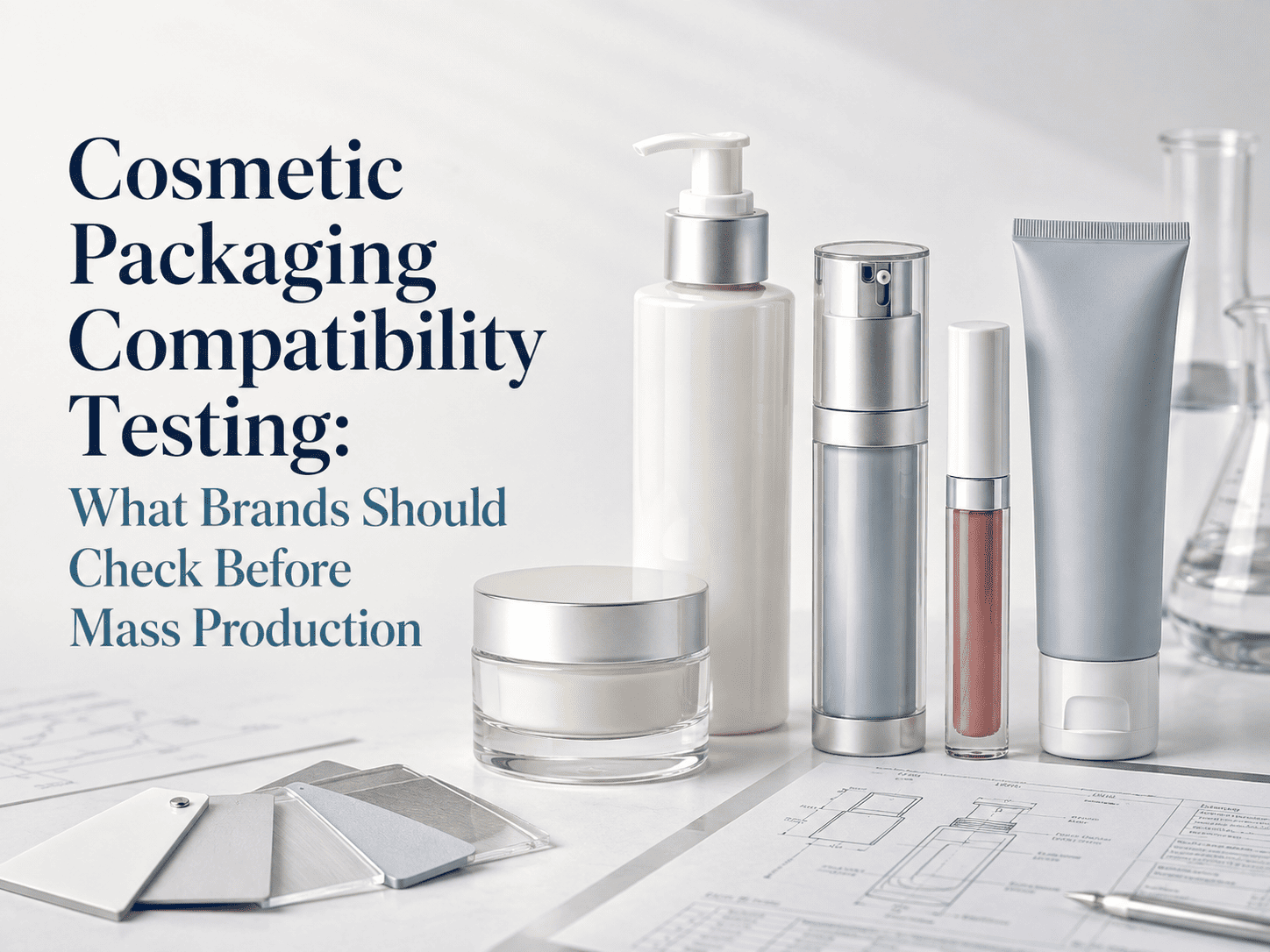
This is why cosmetic packaging compatibility testing should take place before mass production—not after thousands of units have already been filled.
Compatibility testing evaluates how the formula and packaging system affect each other over time. It goes beyond checking whether a bottle fits a cap or whether a pump works on an empty sample.
The real question is:
Will this exact formula remain stable in this exact packaging structure throughout filling, storage, transportation and normal consumer use?
For beauty brands, answering that question early can reduce the risk of recalls, leakage, decoration failure and expensive packaging changes close to launch.
What Is Cosmetic Packaging Compatibility Testing?
Cosmetic packaging compatibility testing evaluates the interaction between the finished cosmetic formula and its intended container.
That includes not only the main bottle or jar, but also components such as:
- Caps and closures
- Pumps and actuators
- Gaskets and seals
- Wipers
- Applicator rods
- Inner plugs
- Pistons
- Tubes
- Adhesives
- Coatings and printed decoration
The European Cosmetics Regulation requires a cosmetic product safety report to consider the relevant characteristics of the packaging material, particularly its purity and stability. It also requires the stability of the cosmetic product under reasonably foreseeable storage conditions. EU Cosmetics Regulation 1223/2009 on EUR-Lex
Industry guidance from Cosmetics Europe also specifically recommends considering both the effect of packaging on the formula and the effect of the formula on the packaging during stability studies. Cosmetics Europe Guidelines on Stability Testing of Cosmetic Products
There is no single universal compatibility test that works for every cosmetic product. The protocol should reflect the formula, package structure, intended shelf life, distribution conditions and target market.
Why Formula and Packaging Can Affect Each Other
A cosmetic package is not chemically neutral in every situation.
Different formulations create different stresses on packaging materials.
A high-oil formula may behave differently from a water-based toner. Alcohol-containing products may place different demands on seals and plastic components than creams. Fragrance oils, surfactants, acids, UV filters and other formulation ingredients may also interact differently with plastics, elastomers, coatings or adhesives.
This does not mean a particular material is inherently unsuitable.
PP, PET, PETG, HDPE, ABS and other materials are widely used across the beauty industry. But material selection should always be considered in relation to the actual formula and package design.
Her Beauty supplies both skincare packaging solutions and makeup packaging solutions in multiple materials and structures. The appropriate package should be selected according to formula properties, functional requirements and the desired consumer experience.
The Main Compatibility Risks Brands Should Check
1. Cracking, Swelling or Deformation
A component may initially look stable but gradually change after extended formula contact.
Possible signs include:
- Stress cracking
- Swelling
- Softening
- Shrinkage
- Warping
- Loss of dimensional accuracy
Even small dimensional changes can affect sealing.
For example, if a bottle neck, wiper or gasket changes slightly after exposure, the package may begin leaking even though the original empty-pack leakage test passed.
2. Formula Changes
Compatibility works in both directions.
The package may also affect the formula.
Brands should monitor changes such as:
- Colour
- Odour
- Appearance
- Viscosity
- pH, where relevant
- Separation
- Weight loss
The EU cosmetics framework specifically recognises packaging characteristics as relevant information for product safety assessment.
A useful stability program therefore evaluates the formula and packaging together rather than treating them as two independent products.
3. Leakage and Seal Performance
Leakage is one of the most commercially damaging packaging failures.
Potential causes include:
- Formula attacking a gasket or seal
- Dimensional changes in the bottle neck
- Incorrect cap torque
- Wiper deformation
- Pump connection failure
- Poor fit between multiple components
Testing should include the actual formula whenever possible.
A package that passes a vacuum test while empty may perform differently after weeks of formula contact.
4. Pump and Dispensing Failure
Compatibility is especially important for pumps and airless systems.
Formula viscosity and chemistry can affect:
- Pump priming
- Dosage
- Actuator return
- Valve movement
- Piston movement
- Product evacuation
For skincare projects using pumps or piston systems, brands can review Her Beauty’s airless bottle packaging options as part of the early package-selection process.
An airless system should not be selected simply because it looks premium. It must work reliably with the intended formulation.
5. Decoration and Surface Failure
Compatibility testing should also include the final decoration wherever possible.
Spray coatings, soft-touch finishes, metallization, printing, hot stamping and labels can react differently when exposed to the product, filling process or repeated consumer handling.
Possible failures include:
- Coating peeling
- Ink migration or fading
- Loss of gloss
- Surface staining
- Adhesive failure
- Metallized finish damage
This is one reason compatibility testing on undecorated packaging alone may not represent the final commercial product.
What Conditions Should Be Tested?
There is no universal temperature and duration that automatically proves compatibility.
Cosmetics Europe notes that stability programs should be adapted to the product and may use different temperatures or stress conditions to help predict performance.
A typical program may include samples stored under several relevant conditions, such as:
- Normal ambient conditions
- Elevated temperature
- Low temperature
- Temperature cycling
- Light exposure where relevant
Packages may also be stored:
- Upright
- Inverted
- On their side
Orientation can reveal leakage or prolonged formula contact with components that would not normally be continuously exposed when the package is upright.
The testing conditions, duration and acceptance criteria should be determined by the brand, formulator or qualified testing partner based on the product.
What Should Be Checked During the Test?
Testing should not consist of simply looking at the samples at the end.
Brands should establish checkpoints and record changes throughout the study.
Formula Checks
Depending on the product, these may include:
- Appearance
- Colour
- Odour
- Viscosity
- pH
- Separation
- Product weight
Packaging Checks
Inspect for:
- Cracks
- Swelling
- Distortion
- Discoloration
- Leakage
- Seal damage
- Coating failure
- Printing deterioration
- Adhesive failure
Functional Checks
The package should also be operated after storage.
For example:
Pump bottles: Check priming, dosage and actuator return.
Airless bottles: Check piston movement, evacuation and dispensing consistency.
Lip gloss packaging: Check wiper performance, pull force, applicator loading and leakage.
Mascara packaging: Check brush withdrawal, wiping, neck sealing and formula buildup.
Stick packaging: Check twisting, product movement and mechanism stability.
A package can remain visually attractive while its mechanism is already beginning to fail.
Test the Final Package, Not Just the Material
One of the most common development mistakes is relying too heavily on material data.
Knowing that a bottle is PET or PP is useful, but it does not fully predict performance.
The final package may also include:
- Different resin grades
- Pigments
- PCR content
- Coatings
- Metal components
- Elastomers
- Adhesives
- Printing
- Internal mechanisms
Geometry also matters.
A thick PP jar and a thin PP hinge do not experience stress in the same way, even though the material name is identical.
The most reliable approach is therefore to test the actual commercial formula in packaging that is as close as possible to the final production specification.
For custom projects, Her Beauty’s private mould development process includes DFM review, rapid prototyping, precision tooling and T1 sample evaluation. Compatibility testing should continue once representative off-tool components and final materials become available.
PCR Packaging Needs Compatibility Testing Too
Brands increasingly want to introduce recycled content into cosmetic packaging.
However, changing from virgin resin to PCR is still a material change.
PCR percentage and resin source can influence:
- Colour
- Clarity
- Processing stability
- Mechanical performance
- Surface appearance
- Decoration results
Therefore, a package that has already passed compatibility testing in virgin material should not automatically be assumed to perform identically after switching to PCR.
Her Beauty’s sustainable packaging solutions include different PCR-content levels, refillable structures and material-reduction concepts. Representative samples should be evaluated before the final material specification is approved.
When Should Compatibility Testing Start?
Testing should begin early enough that problems can still be corrected.
For a stock packaging project, brands should obtain representative samples before confirming the bulk order.
For a custom-mould project, compatibility should be considered during material selection and then verified again with representative production samples.
Testing too late creates expensive choices:
- Change the formula
- Change the packaging
- Modify the mould
- Replace a gasket or pump
- Repeat stability testing
- Delay the launch
The earlier the interaction between formula and packaging is understood, the more options the development team has.
Who Is Responsible for Compatibility Testing?
Compatibility testing is a shared development responsibility.
The packaging manufacturer understands the materials, structure, tolerances and production process.
The formula developer understands the chemistry and stability characteristics of the product.
The beauty brand or responsible person ultimately needs evidence that the finished product and its packaging are suitable for the intended market.
For projects involving filling and assembly, Her Beauty’s turnkey supply-chain service can help coordinate packaging, decoration, filling partners and final assembly through a more integrated workflow.
However, final compatibility should always be confirmed using the customer’s actual formula and an agreed testing protocol.
A Practical Pre-Production Checklist
Before approving mass production, brands should be able to answer:
- Has the final formula been tested in the intended packaging?
- Are all product-contact materials represented?
- Have seals, wipers, pumps and gaskets been included?
- Has decorated packaging been evaluated?
- Were relevant temperature and storage orientations tested?
- Were formula changes recorded?
- Was packaging deformation or leakage checked?
- Were dispensing mechanisms tested after storage?
- Are reference samples and test records available?
- Have any material or decoration changes been re-evaluated?
If the answer to one of these questions is no, the project may still contain an avoidable compatibility risk.
Frequently Asked Questions
How long should cosmetic packaging compatibility testing take?
There is no single duration suitable for every product. Testing should reflect the expected shelf life, formula characteristics, package type and accelerated conditions selected by the responsible technical team.
Can empty packaging leakage tests replace compatibility testing?
No. Empty-pack tests are useful for checking structural sealing, but they cannot predict how the actual formula may affect the package over time.
Should packaging be tested before or after decoration?
Early screening can begin with undecorated samples, but final validation should use packaging representative of the commercial product wherever decoration could influence performance.
Does changing the packaging material require retesting?
Material, resin grade, PCR level, coating, gasket or structural changes may affect compatibility. Significant changes should be assessed to determine whether additional testing is required.
Reduce Packaging Risk Before Mass Production
Cosmetic packaging compatibility testing is not simply another box to check before launch.
It is a way to discover problems while they are still inexpensive to solve.
A successful package must maintain formula stability, prevent leakage, protect its decoration and continue functioning throughout its intended life.
Her Beauty supports beauty brands with packaging material selection, custom mould development, sampling, decoration, production and quality evaluation across skincare and colour cosmetics.
If you are evaluating a new bottle, jar, airless system, lip gloss tube or custom package, send us your formula type, target capacity, packaging requirements and project schedule.
Contact Her Beauty to discuss your cosmetic packaging project before moving into mass production.