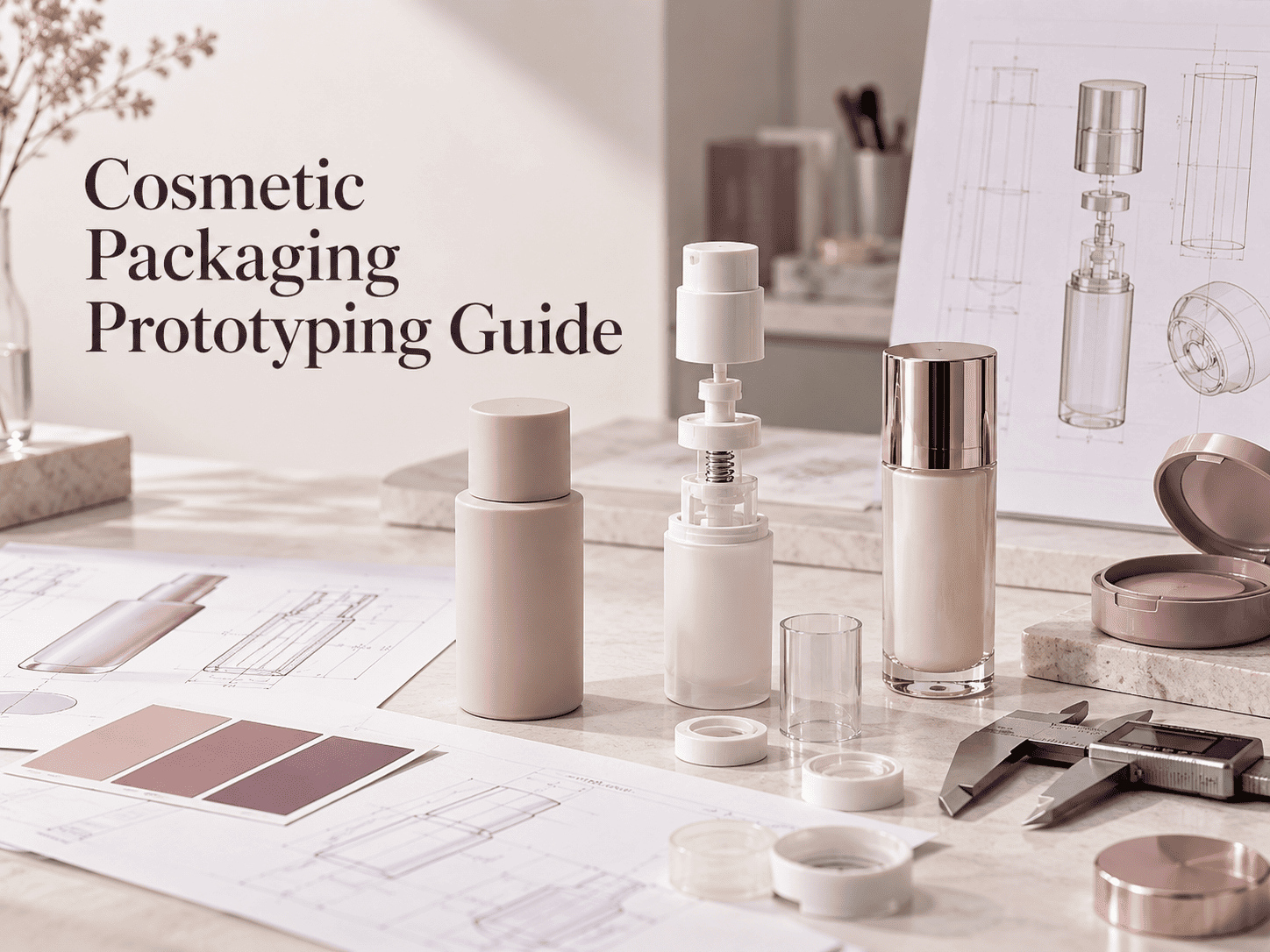
A cosmetic packaging prototype can look successful and still tell you very little about whether the final package is ready for production.
This is one of the most common misunderstandings in custom packaging development.
A beautifully finished prototype may confirm shape and proportion but not injection-moulding performance. A functional model may demonstrate that a cap opens correctly but use materials that behave differently from the final resin. Even a T1 sample made from the production mould may still require dimensional corrections, process optimisation or decoration testing.
Effective cosmetic packaging prototyping therefore begins with one question:
What exactly is this sample supposed to prove?
For beauty brands developing private-mould bottles, lipstick tubes, compacts, sticks or dispensing systems, understanding the difference between appearance samples, functional prototypes and T1 samples can reduce unnecessary revisions and help teams make better decisions before mass production.
Why Cosmetic Packaging Needs More Than One Prototype
Packaging development involves several types of risk at the same time.
The package must look right, fit the brand identity, feel comfortable in the hand, assemble correctly, protect the formula and remain manufacturable at commercial volumes.
One prototype rarely proves all of these things.
Product-development teams commonly distinguish between “looks-like” and “works-like” prototypes. Appearance-oriented models help evaluate design and user perception, while functional prototypes are used to test mechanical behaviour and manufacturability before investing fully in production tooling. Formlabs
Cosmetic packaging adds another important stage: the first samples produced from the actual production mould.
A useful way to think about the three stages is:
| Prototype type | Main question | Best used for | Should not be used to prove |
|---|---|---|---|
| Appearance sample | Does it look and feel right? | Shape, proportion, ergonomics, CMF | Final moulding quality or long-term function |
| Functional prototype | Does the mechanism work? | Fit, movement, assembly, usability | Exact production finish or resin behaviour |
| T1 sample | Can the production mould make the part correctly? | Dimensions, moulding, assembly, surface quality | Final mass-production approval by itself |
Each stage reduces a different type of uncertainty.
1. Appearance Samples: Proving the Design
An appearance prototype is primarily used to evaluate the visual and physical character of a packaging concept.
It may be produced through SLA 3D printing, CNC machining, resin casting or another rapid-prototyping process.
For a cosmetic package, an appearance model can help teams evaluate:
- Overall silhouette and proportion
- Bottle-to-cap relationship
- Component scale
- Ergonomics
- Logo placement
- Colour direction
- Surface texture
- Shelf presence
This stage is particularly valuable when CAD renderings do not provide enough information about scale.
A compact that looks elegant on a screen may feel too thick in the hand. A skincare bottle may look balanced in a rendering but appear too narrow once placed beside competing products.
Modern SLA prototyping can produce highly detailed models and is widely used for concept exploration and high-fidelity “looks-like” prototypes. Formlabs
However, appearance samples have important limitations.
A painted SLA prototype does not necessarily reproduce the exact gloss of injection-moulded ABS. A clear resin prototype may look similar to PETG but behave differently mechanically. A manually assembled sample may achieve a tighter visual gap than the final production components.
The correct conclusion from an appearance sample is therefore:
“The design direction is approved.”
Not:
“The package is ready for production.”
2. Functional Prototypes: Proving Movement and Assembly
Once the general appearance is accepted, the next question is whether the structure works.
A functional prototype is designed to test mechanical behaviour.
For cosmetic packaging, this can include:
- Cap opening and closing
- Snap-fit engagement
- Thread movement
- Twist-up mechanisms
- Hinges
- Refill cartridge removal
- Applicator insertion
- Component assembly
- Grip and ergonomics
A lipstick tube, for example, may look correct externally while the internal cup travels too loosely. A compact lid may have the right proportions but open beyond the desired angle. A refill cartridge may be easy for engineers to remove but difficult for consumers.
Functional prototypes help identify these problems before steel tooling becomes expensive to modify.
Formlabs describes functional prototypes as parts used to validate design assumptions, tolerances, assembly feasibility and usability before production. Protolabs
But functional prototypes also have limitations.
A 3D-printed snap feature may not behave exactly like moulded PP. Surface friction may be different. Flexible parts may use substitute materials. Small clearances may behave differently once resin shrinkage and moulding tolerances are introduced.
So a functional prototype should answer:
“Does this mechanism and assembly concept work?”
It should not automatically answer:
“Will the production mould reproduce this behaviour exactly?”
3. T1 Samples: Proving the Production Tool
The T1 sample represents a major transition.
Instead of being produced by a prototyping process, the component is made from the actual production mould.
A T1 trial is typically the first customer-facing mould trial and is used to assess whether the tool can produce parts that meet the intended design, dimensions, appearance and function. Fictiv
For cosmetic packaging, T1 samples allow the development team to examine factors that earlier prototypes cannot fully reproduce.
These may include:
- Actual resin shrinkage
- Critical dimensions
- Component tolerances
- Gate marks
- Sink marks
- Flash
- Weld or flow lines
- Parting lines
- Warpage
- Surface replication
- Assembly fit
This is why T1 samples are much more meaningful for production validation than an SLA model.
Her Beauty’s current private-mould workflow includes DFM review, SLA/SLS rapid prototyping, precision tooling and T1 sample delivery. Its custom moulding page lists rapid prototyping at approximately 3–5 days, precision tooling around 35 days and first off-tool samples around day 40 for a typical development workflow. Actual timing depends on project complexity. Her Beauty
Explore Her Beauty custom mould development
A T1 Sample Is Not Automatically a Production Sample
This distinction is important.
“T1” means the first meaningful mould trial. It does not mean the tooling is automatically final.
The first trial may reveal that a dimension needs correction, a gate should be adjusted or a surface requires further polishing.
For example, the team may discover that:
- The cap gap is too large
- A snap-fit is too tight
- A lipstick mechanism has excessive resistance
- A transparent component shows flow marks
- A wall section produces sink
- A decorative surface requires additional polish
The mould may then be modified before another trial.
Depending on the supplier, later rounds may be described as T2, T3 or simply revised off-tool samples.
The goal is not to make T1 perfect at any cost.
The goal is to use T1 to reveal what the production tooling actually produces, then correct the differences between the design intent and the physical result.
What Should Brands Check on T1 Samples?
T1 review should be more disciplined than simply placing the sample on a table and asking whether it looks good.
Begin with the dimensions that actually control function.
For a compact, those may include hinge geometry and closure engagement. For a lipstick tube, they may include cup diameter and mechanism alignment. For a bottle, neck dimensions and closure fit may be critical.
Then review visual quality.
Clear and high-gloss cosmetic packaging can reveal moulding defects that are less visible on internal industrial parts. Surface polish, texture, parting lines, flow marks and gate location therefore deserve careful attention.
Finally, assemble the complete package.
Individual parts can measure correctly while tolerance accumulation creates an unacceptable finished assembly.
The package should be evaluated as the consumer will receive it—not only as separate components.
Where Do Decoration Samples Fit?
Decoration usually becomes more meaningful after the underlying component is stable.
A spray-coated, metallized or hot-stamped prototype can help confirm appearance earlier in development, but final decoration approval should ideally use representative production-moulded components.
The substrate affects how decoration appears.
Gloss, texture, resin colour and geometry can change the visual result.
This is especially important when several materials need to share one brand colour. Her Beauty’s guide to cosmetic packaging color matching explains why plastic, glass and metal can require different production formulations to achieve one visually coordinated result. Her Beauty
Read the Cosmetic Packaging Color Matching guide
Compatibility Testing Comes After the Structure Becomes Representative
A prototype may confirm shape and mechanics without proving formula compatibility.
The most useful compatibility testing begins when samples represent the intended production resin, contact components and structure closely enough to simulate the commercial package.
This means a painted SLA bottle should not normally be treated as evidence that the final moulded package is compatible with the formula.
Once representative off-tool components are available, brands can evaluate interactions involving the formula, gasket, pump, wiper, coating and other relevant components.
Her Beauty’s existing guide explains how cosmetic packaging compatibility testing can reveal cracking, swelling, leakage, formula changes and dispensing problems before mass production. Her Beauty
Read the Cosmetic Packaging Compatibility Testing guide
A Better Prototype Approval Process
The simplest way to avoid confusion is to give every sample a specific approval purpose.
At the appearance stage, approve shape, proportion and design direction.
At the functional stage, approve movement, user interaction and assembly concepts.
At T1, evaluate the actual mould, production material, critical dimensions, surface quality and assembled performance.
Only after those questions are resolved should the team progress toward decoration approval, compatibility validation, pilot production and final mass production.
This prevents a common mistake:
Using a successful sample as evidence for something that sample was never designed to prove.
Cosmetic Packaging Prototyping at Her Beauty
Her Beauty supports custom cosmetic packaging from early design review through tooling and production.
Its private-mould development process combines DFM, rapid prototyping, CNC tooling and off-tool sample evaluation, while the wider manufacturing workflow covers injection moulding, decoration, assembly and quality control. Her Beauty
For projects involving packaging, filling and multiple components, Her Beauty also provides a coordinated turnkey workflow across packaging development, decoration and assembly. Her Beauty
Explore Her Beauty Turnkey Service
When starting a custom project, useful information includes the product category, target capacity, reference design, preferred material, expected quantity and functional requirements.
The earlier these requirements are defined, the more effectively each prototype stage can answer the right question.
Frequently Asked Questions
Is an SLA prototype suitable for mass-production approval?
No. SLA prototypes are highly useful for evaluating appearance, ergonomics and certain functional concepts, but they do not reproduce every characteristic of the final injection-moulding process.
What does T1 mean in injection moulding?
T1 generally refers to the first major trial of the production mould and the first set of samples used to evaluate mould performance, dimensions, appearance and assembly.
Can a functional prototype replace a T1 sample?
No. A functional prototype can validate a mechanism before tooling, but T1 samples reveal how the actual production mould and material behave.
Should brands approve decoration on prototype samples?
Early decorated prototypes are useful for design decisions, but final colour and finish approval should ideally use representative production-moulded components.
Prototype With a Purpose
Successful cosmetic packaging development is not about producing the most realistic prototype as early as possible.
It is about asking the right question at each stage.
An appearance sample should prove the design.
A functional prototype should prove the mechanism.
A T1 sample should prove what the production mould can actually make.
When those roles are clearly separated, brands can make faster decisions, identify engineering problems earlier and avoid unnecessary tooling changes close to launch.
For a new private-mould lipstick tube, compact, skincare bottle, stick package or other custom structure, Her Beauty can support the project from initial DFM and rapid prototyping through mould development and mass production.