A mascara brush can look impressive and still perform poorly once it is paired with the wrong formula or wiper.
The same is true in reverse.
A well-designed mascara formula may feel too dry, overloaded or difficult to apply if the packaging removes too much product from the brush—or not enough.
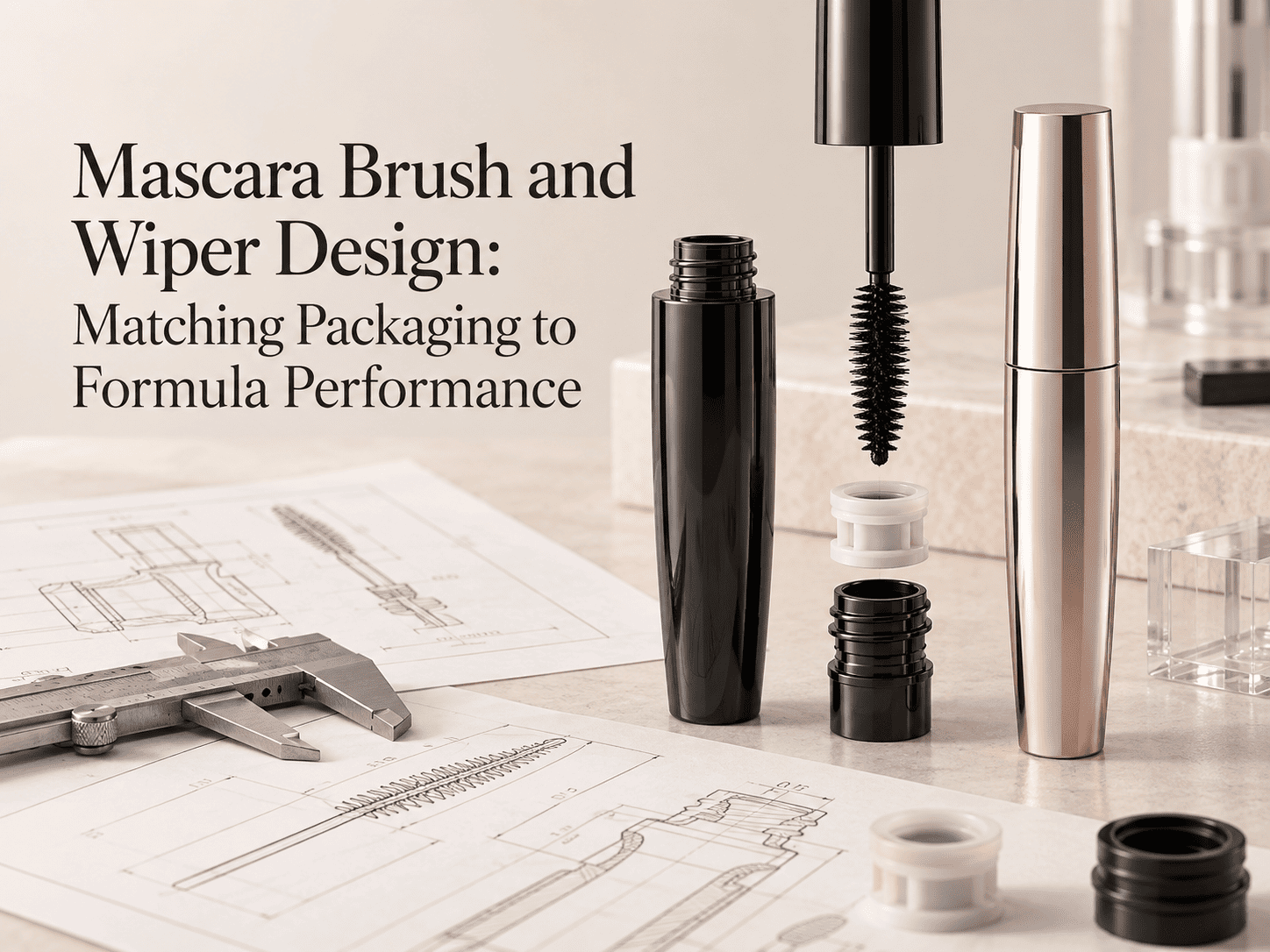
This is why mascara brush packaging should be developed as a complete dispensing system rather than as separate bottle, brush and formula decisions.
The brush, rod, wiper, bottle neck and formula all influence how much product reaches the applicator, how evenly it is distributed and how the package behaves after repeated use.
For beauty brands, the important question is not simply:
Which mascara brush looks best?
It is:
Which brush and wiper combination delivers the intended formula in a controlled and repeatable way?
Mascara Packaging Is a System
A typical mascara package includes several components working together:
- Bottle
- Neck
- Wiper
- Rod
- Brush
- Cap
- Formula
Each component influences the next.
The formula coats the brush. The wiper removes excess product. The rod passes through the wiper every time the package is opened and closed. The bottle neck and closure must maintain sealing, while the brush must hold enough product for application without excessive clumping or dripping.
This means changing one element can affect the complete user experience.
For example, reducing the wiper opening may remove more formula from the rod and brush. That may improve cleanliness for one formula but leave another formula feeling too dry during application.
A larger brush may provide more contact area, but it may also require different bottle-neck clearance and wiper geometry.
Her Beauty currently offers mascara bottles within its broader makeup-packaging range and supports custom packaging development for brand-specific structures. Her Beauty
Explore Her Beauty mascara bottle packaging
The Brush Does More Than Apply Product
The mascara brush determines how the formula is presented to the lashes.
Common brush variables include:
- Overall diameter
- Brush length
- Bristle length
- Bristle density
- Bristle spacing
- Brush profile
- Tip geometry
- Flexibility
- Core structure
Brushes may be made using twisted-wire fiber construction or moulded plastic/elastomer structures, depending on the desired application style.
Different geometries can support different application goals.
A fuller cylindrical brush may be developed for broad lash coverage. A tapered brush can make it easier to reach shorter lashes near the corners of the eye. Curved profiles may support contact along the lash line, while more separated comb-like structures can help control formula distribution.
However, the brush shape alone does not determine the result.
The same brush can behave very differently when used with two formulas of different viscosity, solids content or drying behaviour.
That is why brush selection should take place with the actual formula—or a close representative formula—rather than from appearance alone.
Why the Wiper Is Critical
The wiper is one of the smallest components in mascara packaging, but it has a major influence on dispensing performance.
It sits inside the bottle neck and removes excess formula as the rod and brush are withdrawn.
Important wiper variables include:
- Internal opening diameter
- Lip geometry
- Material stiffness
- Contact pressure on the rod
- Depth
- Relationship to brush diameter
A tighter wiping action generally removes more product.
A more open wiping system generally leaves more formula on the applicator.
But neither is automatically better.
The correct balance depends on the formula and application target.
If too much product remains on the brush, the consumer may experience:
- Heavy loading
- Clumping
- Dripping
- Product around the bottle neck
- Messy application
If too much product is removed, the brush may feel:
- Dry
- Underloaded
- Inefficient
- Unable to build coverage quickly
The wiper therefore acts as a dosage-control component, even though it does not dispense product in the same way as a pump.
Her Beauty has also discussed how wipers and internal components influence dosage and user experience in other cosmetic packaging formats. Her Beauty
Wiper Diameter and Rod Diameter Must Be Developed Together
The relationship between the rod and wiper is especially important.
When the rod passes through the wiper, there is controlled interference between the two components.
If that relationship is too loose, excess formula may remain on the rod, creating mess around the opening.
If it is too tight, withdrawal force can become uncomfortable and the wiper may remove more product than intended.
Manufacturing tolerance matters here.
A change of only a small amount in component dimensions can alter:
- Pull force
- Formula scraping
- Rod cleanliness
- Wiper deformation
- Long-term sealing behaviour
This is why mascara packaging should be evaluated using production-representative components rather than only hand-made prototypes.
For fully custom projects, Her Beauty’s custom moulding process includes DFM, rapid prototyping, precision tooling and T1 sample evaluation before mass production. Her Beauty
Explore Her Beauty custom mould development
Match the Brush and Wiper to Formula Behaviour
Mascara formulas vary significantly.
Some are relatively fluid and easy to spread. Others are creamy, highly pigmented, fiber-rich, wax-heavy or designed to set quickly.
Packaging should respond to those differences.
A useful early-development framework is:
| Formula behaviour | Packaging areas to evaluate |
|---|---|
| More fluid / lower viscosity | Wiping control, dripping, rod cleanliness, sealing |
| Creamy / medium viscosity | Pickup balance, brush loading, lash separation |
| Thick / high solids | Wiper clearance, withdrawal force, product buildup |
| Fiber-containing | Brush spacing, wiper clearance, clogging |
| Quick-setting / water-resistant | Neck buildup, dried residue, repeated opening |
These are development considerations rather than universal specifications.
There is no single wiper diameter or brush density that is correct for every mascara.
Cosmetics Europe notes that cosmetic stability testing should take account of both the effect of packaging on the product and the effect of the product on its packaging, and that testing protocols need to reflect the specific formula and package rather than follow one universal method. Cosmetics Europe –
Read Cosmetics Europe guidance on cosmetic stability testing
Brush Loading Should Be Tested After Repeated Use
A new mascara package may behave differently after repeated opening and closing.
Formula gradually accumulates around:
- Brush bristles
- Brush core
- Rod
- Wiper edge
- Bottle neck
Some formulas may also become thicker during repeated consumer use because of normal product exposure and changes over time.
For this reason, evaluation should not stop after the first withdrawal.
Development teams should check:
- First-use brush loading
- Repeated withdrawals
- Rod cleanliness
- Neck buildup
- Wiper stability
- Closure cleanliness
- Brush consistency
- Application feel over time
A package that looks clean during the first few cycles may become messy after repeated operation.
Functional cycling can therefore reveal issues that a single visual inspection will miss.
Brush Size Must Match the Bottle Opening
Large mascara brushes are visually distinctive, but they create additional structural requirements.
The brush must pass through the bottle neck and wiper without damaging the bristles or creating excessive withdrawal resistance.
Development teams need to consider:
- Maximum brush diameter
- Wiper opening
- Bottle neck diameter
- Brush compression during withdrawal
- Recovery of the brush after wiping
- Clearance during insertion
If the geometry is too tight, the brush may deform excessively.
If it is too open, wiping control may be reduced.
This becomes particularly important with moulded brushes that have carefully defined teeth or comb structures. The wiper should remove excess product without damaging the intended applicator geometry.
Do Not Ignore the Brush Tip
The tip of the mascara applicator is often treated as a minor detail, but it affects both application and packaging behaviour.
A tapered or reduced-diameter tip can help the consumer reach shorter lashes.
However, the tip also collects formula during withdrawal.
If wiping around the tip is poorly controlled, the consumer may receive a large deposit of formula at the end of the brush.
This can cause:
- Excess product transfer
- Smudging
- Clumping
- Mess around the eye area
Because mascara applicators are used close to the eye, controlled applicator design and clean use are particularly important. The U.S. FDA advises consumers to keep eye-cosmetic applicators clean and warns that mascara applicators can cause eye injury if used improperly. U.S. Food and Drug Administration
Read FDA guidance on eye cosmetic safety
Packaging design cannot eliminate all consumer-use risks, but a well-controlled applicator should support clean and predictable use.
Formula Compatibility Still Matters
Even when brush loading feels correct, the complete mascara package still needs compatibility evaluation.
The formula remains in prolonged contact with the bottle, wiper and other internal components.
Brands should monitor possible changes involving:
- Wiper swelling or deformation
- Material softening
- Leakage
- Neck sealing
- Formula appearance
- Odour
- Viscosity
- Product buildup
- Brush withdrawal behaviour
Changes in wiper dimensions during storage can alter the amount of formula removed from the brush, meaning compatibility failure can become an application-performance problem as well as a packaging problem.
Her Beauty’s existing Cosmetic Packaging Compatibility Testing guide explains why the actual formula should be evaluated with representative packaging before mass production. Her Beauty
Read the Cosmetic Packaging Compatibility Testing guide
A Better Mascara Development Process
A structured mascara-packaging development process can reduce repeated sampling.
1. Define the Formula
Understand viscosity, solids content, fibers, drying behaviour and intended application result.
2. Define the Consumer Effect
Is the product intended to emphasise separation, buildable coverage, precision or another specific application experience?
3. Select the Brush
Choose an initial brush profile, diameter, length and bristle structure based on the desired application.
4. Tune the Wiper
Evaluate the wiper opening and contact with the rod to control formula removal.
5. Test Brush Loading
Check the brush immediately after withdrawal and after repeated cycles.
6. Evaluate the Complete Package
Review sealing, neck cleanliness, pull force, application and consumer handling.
7. Run Compatibility Testing
Test representative production packaging with the intended formula under appropriate storage conditions.
The key is to evaluate the components together.
A brush should not be approved independently from the wiper, and the wiper should not be approved independently from the formula.
Common Mascara Packaging Mistakes
Choosing a Brush Only From Appearance
A distinctive applicator may support brand differentiation, but application performance should remain the primary decision factor.
Using One Wiper for Different Formulas
Two formulas can require different wiping behaviour even when they use the same bottle and brush.
Ignoring Manufacturing Tolerance
Small dimensional differences in the rod, wiper or neck can change withdrawal force and product loading.
Testing Only a Fresh Package
Repeated use may reveal residue, buildup or wiping issues that are not visible during the first application.
Changing the Formula Without Retesting
A change in viscosity, wax system, fibers or other formula characteristics can affect the brush-and-wiper system.
Frequently Asked Questions
Does a larger mascara brush hold more formula?
Not necessarily. Brush diameter, bristle geometry, formula viscosity and wiper design all influence how much product remains after withdrawal.
What does the mascara wiper do?
The wiper removes excess formula from the rod and brush and helps control the amount of product presented to the user.
Can the same mascara package be used with different formulas?
Potentially, but each formula should be evaluated with the brush, wiper and bottle system. Different viscosities or solids levels may require adjustments.
When should mascara packaging be tested with the final formula?
As early as practical during package selection, with final compatibility and functional testing performed on production-representative components before mass production.
Develop Mascara Packaging as One System
Successful mascara packaging is not created by selecting a bottle, brush and formula independently.
The formula determines how product moves.
The brush determines how it is held and applied.
The wiper determines how much remains on the applicator.
The rod, neck and closure determine how consistently that system operates.
When those elements are developed together, the package can deliver cleaner withdrawal, more predictable application and a more consistent consumer experience.
Her Beauty supports custom mascara packaging development, including bottle selection, brush and wiper coordination, private mould development, decoration, sampling and production.
Explore Her Beauty makeup packaging solutions
For a new mascara project, provide the formula type, target fill volume, preferred brush direction, expected order quantity and visual reference.