
A cosmetic package can pass visual inspection and still leak after filling.
The cap may look perfectly aligned. The pump may operate smoothly. The bottle and closure may fit correctly when empty. Yet after the formula is added, the same package can begin leaking during storage, transportation or repeated consumer use.
This is why cosmetic packaging leak testing should be treated as part of packaging engineering—not simply as a final quality-control check.
A reliable leak-testing program needs to answer a more useful question than:
“Does this bottle leak right now?”
It should ask:
“Where could this complete package fail under the conditions it will actually experience?”
For beauty brands, identifying those risks before mass production can reduce product loss, damaged cartons, customer complaints and expensive rework after filling.
Where Does Cosmetic Packaging Usually Leak?
Leakage does not always originate from an obvious crack.
In many cosmetic packages, the most important leakage paths are the interfaces between components.
Common areas include:
- Bottle neck and closure
- Threads
- Gaskets and sealing surfaces
- Pump connections
- Actuator assemblies
- Wipers
- Inner plugs
- Dropper assemblies
- Airless pump systems
- Refill cartridges
Even small dimensional changes can affect sealing.
For example, a cap may fit the bottle correctly but fail to apply enough compression to the sealing surface. A lip gloss wiper may seal properly when new but deform after prolonged formula exposure. A pump may remain secure upright yet show leakage when the package is stored horizontally.
Leak testing therefore needs to evaluate the complete structure rather than only the container body.
Why Empty Packaging Testing Is Not Enough
Empty-component testing is useful.
It can reveal mould defects, dimensional problems, poor assembly or obvious seal failures before filling.
But it cannot reproduce every condition of the finished commercial product.
Once formula is introduced, several variables change:
- Internal surfaces remain in prolonged contact with the product
- Gaskets or wipers may swell or soften
- Formula can migrate into thread areas
- Viscosity affects how easily product escapes through small gaps
- Temperature changes can alter formula behaviour
- Internal pressure can change during transportation
This is why leak testing and packaging compatibility testing should work together.
Cosmetics Europe recommends evaluating the actual product in packaging as similar as possible to the final commercial package, including different orientations where appropriate, because the formula, package and environment can interact during storage.
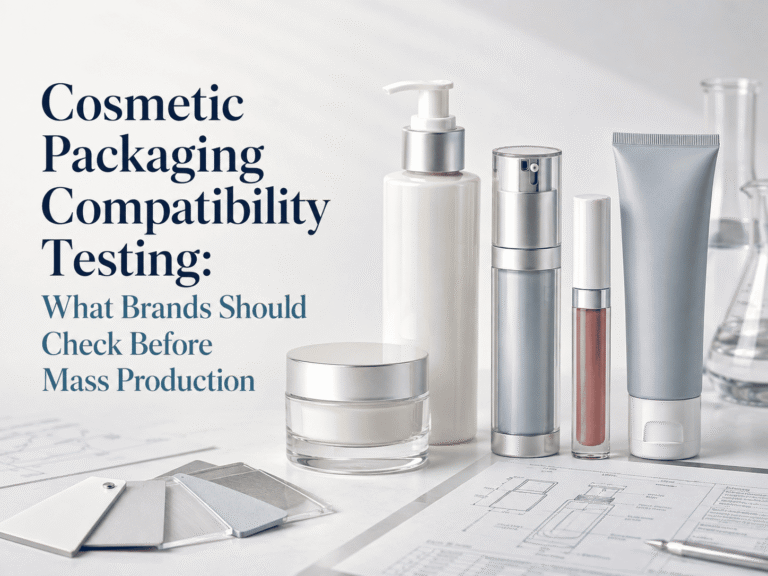
Her Beauty discusses these interactions in more detail in its Cosmetic Packaging Compatibility Testing guide.
1. Vacuum Leak Testing
Vacuum testing is one of the most useful tools for identifying package-integrity problems.
The principle is straightforward: the package is exposed to a reduced-pressure environment, creating a pressure difference between the inside and outside of the container.
If a seal or connection is weak, that pressure difference can reveal leakage that may not be obvious during normal visual inspection.
Her Beauty’s current manufacturing information lists vacuum leakage testing as part of its packaging quality-control process.
However, “vacuum test” can describe different methods.
For example, ASTM F2338 describes a vacuum-decay method in which changes in chamber pressure are monitored to detect leaks without introducing dye or tracer gas. The method can be applied to rigid nonporous packages, among other package types, although the suitability and acceptance criteria must be established for the specific package being evaluated.
ASTM F2338 vacuum decay standard
A beauty brand should not simply request “vacuum testing” without defining:
- Test method
- Vacuum level
- Test duration
- Filled or empty condition
- Sample quantity
- Package orientation
- Pass/fail criteria
The test needs to reflect the package and risk being investigated.
2. Inverted and Horizontal Storage
One of the simplest packaging evaluations can also be one of the most revealing.
Store the filled package:
- Upright
- On its side
- Inverted
Why?
Because many packages spend most of their development time standing upright on a laboratory bench.
Real products do not.
They may lie horizontally in a handbag, travel upside down in a carton or remain inverted during shipping.
Changing the orientation creates prolonged formula contact with components such as:
- Caps
- Wipers
- Gaskets
- Pumps
- Inner plugs
Cosmetics Europe specifically notes that packaged products may be tested upright, inverted or on their side as part of stability evaluation.
A package that remains clean upright but leaks after several days inverted may have a sealing or compatibility issue that would otherwise remain hidden.
3. Closure Torque Matters
For threaded packaging, leak performance is closely connected to closure torque.
If a cap is applied with insufficient torque, the sealing surface may not compress correctly.
Too much torque can also create problems, such as:
- Thread damage
- Component deformation
- Stress in plastic parts
- Difficult consumer opening
- Gasket over-compression
The objective is therefore not “the tighter, the better.”
It is a controlled torque range that produces reliable sealing without damaging the package or compromising usability.
Her Beauty currently lists torque testing alongside vacuum leak testing within its QC capabilities.
Closure engineering also influences the sensory experience of the finished product. Her Beauty’s Cosmetic Packaging Closures guide explains how threads, snap fits, magnets and other closure mechanisms influence both performance and perceived quality.
4. Pumps Need Their Own Leakage Evaluation
Pump packaging introduces additional possible leakage paths.
These may include:
- Pump-to-neck connection
- Gasket
- Actuator
- Stem
- Locking mechanism
- Internal valve structure
Testing only the bottle and closure interface is therefore insufficient.
A filled lotion or serum package should be evaluated after pump assembly and under realistic storage conditions.
Development teams should check for:
- Product around the pump collar
- Leakage through the actuator
- Formula around the stem
- Loss of sealing after repeated use
- Changes after temperature exposure
Pump output and leakage should also be evaluated together.
A pump that remains perfectly sealed but cannot dispense the formula consistently is not a successful package.
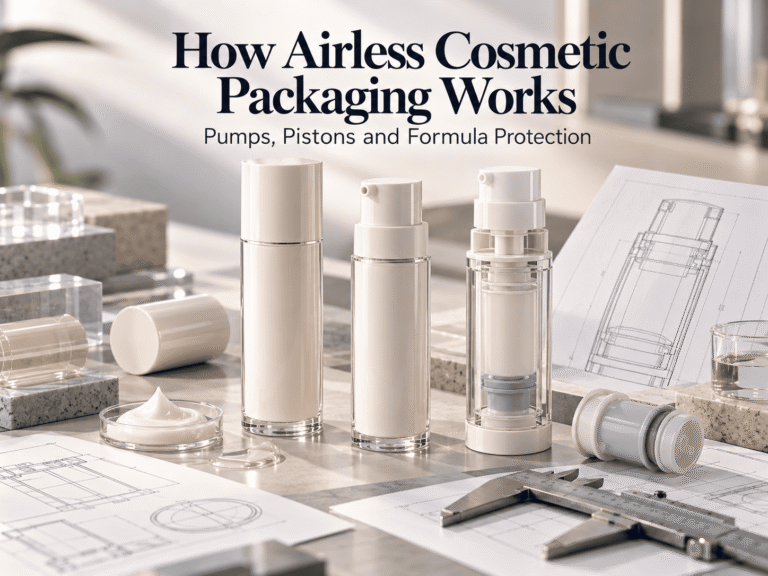
5. Airless Packaging Requires System-Level Testing
Airless packaging creates a different set of risks because the package depends on a pump, seals and a piston or flexible inner system working together.
Potential failure points include:
- Pump connection
- Actuator outlet
- Piston fit
- Inner bottle
- Refill cartridge interface
- Closure and collar
A leak can disrupt more than product containment.
It may affect the pressure relationship needed for correct piston travel and dispensing.
This is why airless packaging should be tested for:
- Leakage
- Priming
- Pump output
- Actuator return
- Piston travel
- Product evacuation
Her Beauty’s current Airless Bottle Packaging range includes several skincare structures and capacities that can be evaluated according to formula and dispensing requirements.
An airless bottle should never be selected only because the package looks premium. The formula, pump and internal system need to function together.
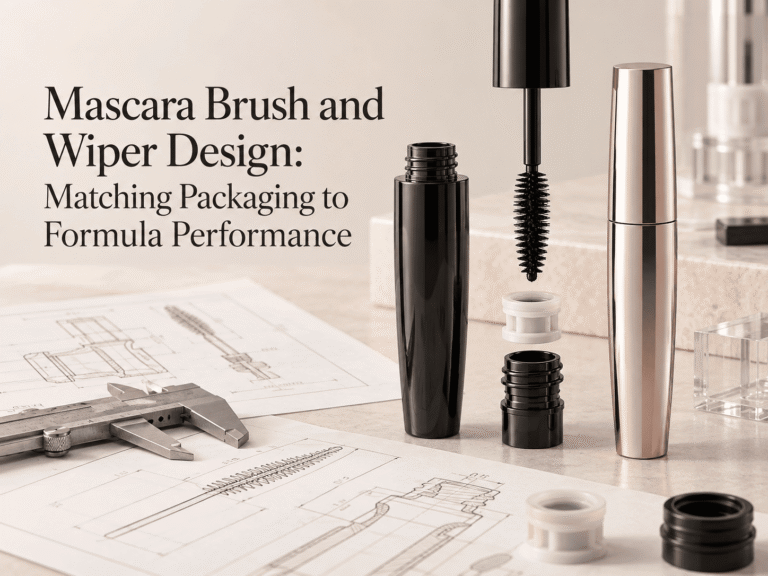
6. Lip Gloss and Mascara Need Wiper Testing
Wipers perform two jobs.
They help control the amount of product left on the applicator, but they also form part of the sealing system around the bottle neck and rod.
In lip gloss or mascara packaging, problems may appear when:
- Wiper dimensions are incorrect
- Rod and wiper tolerances do not match
- Formula changes the wiper material
- Excess product accumulates around the neck
- Cap compression is insufficient
This can lead to product around the threads, dirty necks or leakage during transportation.
Testing should therefore include repeated insertion and withdrawal of the applicator, not just a single static leak test.
A package may perform correctly when new and gradually become messier as product accumulates around the wiper and neck.
7. Temperature Can Reveal Hidden Leaks
Cosmetic packaging rarely remains at one constant temperature throughout its life.
Products may experience:
- Warm warehouses
- Cold transportation
- Hot delivery vehicles
- Seasonal temperature changes
Temperature can influence both the package and formula.
Plastic dimensions can change slightly. Seals can behave differently. Formula viscosity can increase or decrease.
Cosmetics Europe notes that high-temperature, low-temperature and temperature-cycling studies can reveal package problems such as distortion, cracking or label failure and should be considered according to expected shipping and storage conditions.
This does not mean every beauty package needs the same temperature protocol.
The appropriate conditions should be selected according to the formula, package, target markets and distribution conditions.
Leak Testing vs Compatibility Testing
These two tests are related, but they are not the same.
Leak testing asks:
Can the formula escape through the package?
Compatibility testing asks:
Does prolonged contact between the formula and packaging cause changes that could affect the product or package?
A package may pass its initial leakage test but later begin leaking because a gasket swells or a wiper deforms.For a deeper explanation of formula–package interaction, read our Cosmetic Packaging Compatibility Testing guide.
Likewise, a package can remain leak-free while the formula changes colour or viscosity.
This is why the two evaluations should complement each other rather than substitute for each other.
For more detail, see Her Beauty’s Cosmetic Packaging Compatibility Testing: What Brands Should Check Before Mass Production.
A Better Pre-Production Leak Testing Process
A practical approach is to test in stages.
Stage 1: Empty Packaging
Check component fit, dimensional consistency and basic package integrity.
Stage 2: Filled Samples
Use the intended formula or the most representative available formula.
Stage 3: Multiple Orientations
Evaluate upright, horizontal and inverted storage where appropriate.
Stage 4: Environmental Stress
Apply relevant temperature or transportation conditions.
Stage 5: Functional Cycling
Operate pumps, caps, wipers or mechanisms repeatedly.
Stage 6: Final Inspection
Check for:
- Visible leakage
- Product around threads
- Wet pump collars
- Seal deformation
- Component loosening
- Changes in opening torque
- Decoration damage
- Formula changes
Test conditions and acceptance criteria should be agreed before testing begins.
Otherwise, the team may complete a test without having a clear definition of what constitutes a pass.
Common Leak-Testing Mistakes
Testing Only Empty Containers
Empty testing cannot reveal formula-related changes in seals, wipers or other contact components.
Testing Only Upright
A package that performs well standing vertically may fail during horizontal transportation.
Assuming Higher Torque Always Improves Sealing
Excessive torque can damage threads or deform components.
Testing Only One Sample
A single successful package does not prove production consistency.
Sample size should reflect project risk and the agreed quality plan.
Treating Vacuum Testing as the Only Test
Vacuum testing is useful, but it does not reproduce every failure mode.
Orientation, compatibility, temperature and functional testing may reveal different risks.
Frequently Asked Questions
What is cosmetic packaging leak testing?
Cosmetic packaging leak testing evaluates whether bottles, jars, pumps, caps, wipers and other components maintain seal integrity under defined conditions before mass production.
Can vacuum testing guarantee that a package will never leak?
No. Vacuum testing evaluates specific failure conditions. Formula compatibility, temperature, torque, orientation, transportation and repeated use can introduce other risks.
Should leak testing use the actual formula?
Where practical, yes. The formula may influence seals, viscosity and component compatibility, so representative filled testing provides more useful evidence than empty testing alone.
When should leak testing begin?
Initial structural tests can begin during sample development, while final validation should use packaging and formula that are as close as possible to commercial production.
Prevent Leakage Before It Becomes a Market Problem
A leak is rarely just a bottle problem.
It can result from the relationship between the bottle neck, closure, gasket, pump, wiper, formula, assembly process and transportation environment.
Effective cosmetic packaging leak testing therefore requires more than one test.
Vacuum testing can expose seal weaknesses. Torque testing can verify closure control. Inverted storage can reveal hidden leakage paths. Compatibility testing can show whether formula exposure changes sealing components over time.
Together, these evaluations provide a more realistic picture of how the finished package will perform.
Her Beauty’s manufacturing workflow includes vacuum leak testing, torque testing, assembly inspection and coordinated filling and assembly support. Its Turnkey Service also includes on-site QC supervision for filling, sealing and final assembly.
For a new bottle, jar, pump, mascara, lip gloss or airless packaging project, define the formula, package structure, filling method and expected distribution conditions before setting the leak-testing protocol.
The earlier potential leakage paths are identified, the easier—and less expensive—they are to correct before mass production.
Her Beauty’s Turnkey Service supports packaging development, filling coordination, assembly and quality control across the production process.Contact Her Beauty to discuss leak testing and packaging validation for your project.