
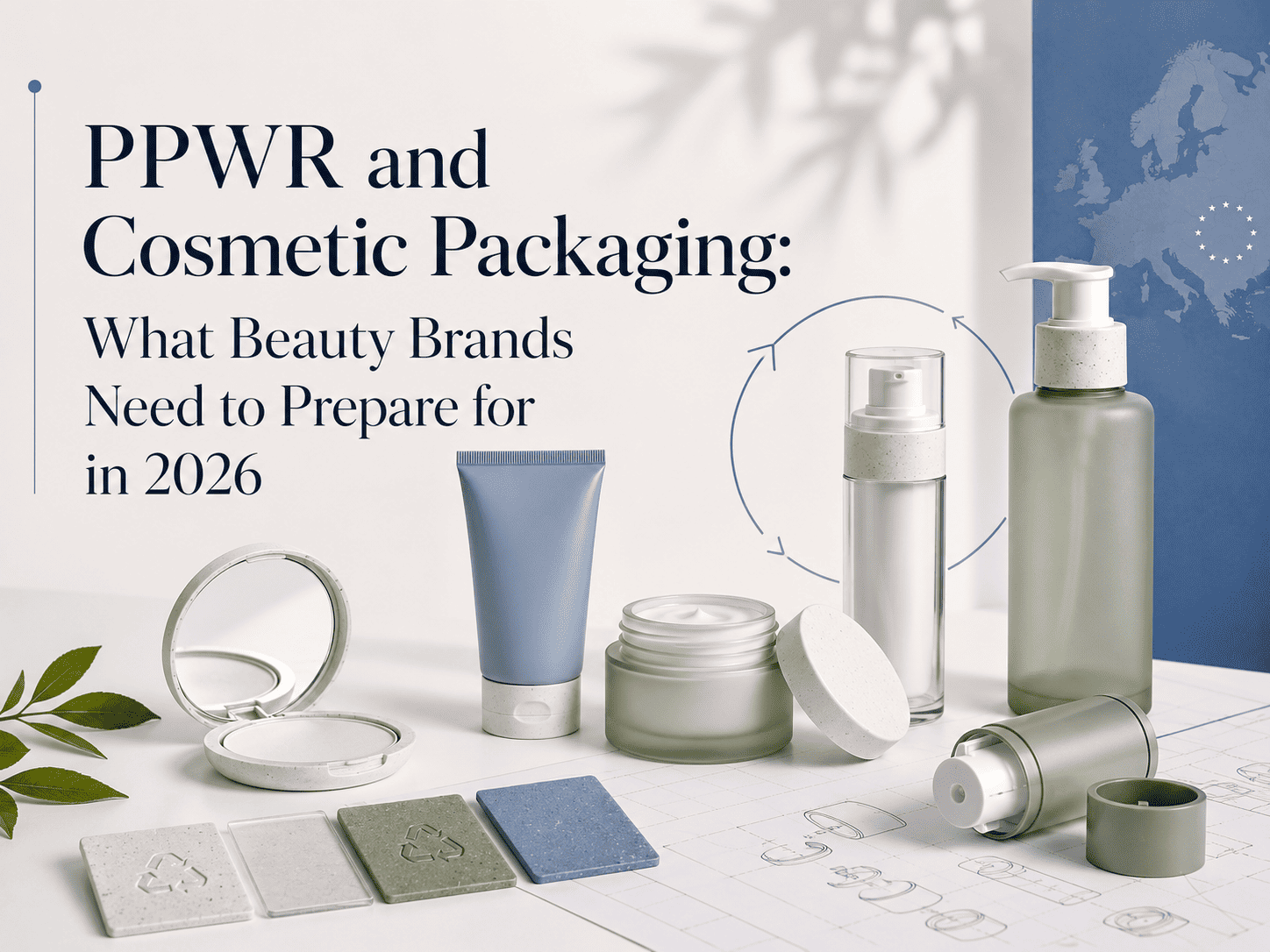
The European Union’s Packaging and Packaging Waste Regulation is changing how beauty brands design, source and document cosmetic packaging.
Regulation (EU) 2025/40, commonly known as the PPWR, entered into force on 11 February 2025 and generally applies from 12 August 2026. It covers packaging placed on the EU market regardless of material or origin and introduces requirements covering recyclability, recycled content, packaging minimisation, labelling, reuse and waste management.
For beauty brands, PPWR preparation cannot be limited to replacing a bottle material or adding a recycling symbol.
A cosmetic package may contain a plastic container, pump, metal spring, gasket, collar, label, adhesive and several decoration layers. A compact case may combine different plastics with a mirror, magnets, a hinge pin and an internal pan.
Every component can affect how the complete package is identified, documented, sorted and recycled.
Many major PPWR design requirements begin from 2030 or later. However, 2026 is the year beauty brands should start collecting packaging data, reviewing high-risk structures and updating supplier requirements.
What Does PPWR Mean for Cosmetic Packaging?
The PPWR replaces the previous EU Packaging and Packaging Waste Directive with a regulation intended to create more harmonised rules across the European Union.
Its principal objectives include:
- Reducing unnecessary packaging
- Improving packaging recyclability
- Increasing post-consumer recycled content
- Supporting reuse and refill systems
- Improving packaging and sorting information
- Reducing dependence on virgin resources
The regulation applies across the packaging life cycle, from design and manufacturing to use and waste management.
Beauty brands can review the complete PPWR legal text on EUR-Lex and the European Commission’s official PPWR overview.
The European Commission also published an official PPWR FAQ and implementation guidance in March 2026. Further technical criteria and implementing measures will continue to shape how individual requirements are applied.
Brands should therefore monitor official EU sources and obtain qualified regulatory advice for their specific packaging and supply-chain arrangements.
Key PPWR Dates for Beauty Brands
PPWR requirements do not all begin on the same date.
12 August 2026: General Application
The PPWR generally applies from 12 August 2026.
By this point, beauty brands should understand which packaging they place on the EU market, which companies act as manufacturers or importers and what component information is available from packaging suppliers.
2030: Major Design Requirements
From 2030, important requirements relating to design for recycling, recycled content and packaging minimisation begin to apply.
The regulation introduces recyclability performance grades based on design-for-recycling criteria. It also sets minimum post-consumer recycled-content requirements for certain plastic packaging categories, subject to the applicable classification, calculation methods and exemptions.
2035: Recycling at Scale
From 2035, recyclability assessments will consider whether packaging is collected, sorted and recycled at scale, rather than only whether it is theoretically recyclable.
This is especially relevant to small, dark, highly decorated or multi-material cosmetic components that may be difficult to recover through established recycling systems.
Stricter recyclability performance requirements are introduced from 2038. A private packaging mould developed in 2026 may still be in production after these later requirements begin, so brands should consider long-term design viability before approving new tooling.
1. Understand Every Packaging Component
The first practical step is to create a complete packaging inventory.
For each product, brands should document:
- Every packaging component
- Material type
- Component weight
- Decoration process
- Recycled-content percentage
- Supplier
- Relevant specifications and declarations
A description such as “plastic airless bottle” is not detailed enough.
A more useful record may identify a PP bottle, PP actuator, PE gasket, metal spring, ABS collar, UV coating and silk-screen printing as separate elements.
This component-level information helps brands find:
- Mixed-material structures
- Unnecessary decorative parts
- Missing supplier information
- Components that may be difficult to separate
- Packaging that may require future redesign
The inventory should include primary packaging, labels, refill cartridges, secondary cartons, gift sets and e-commerce packaging.
2. Design Packaging for Recycling
PPWR cosmetic packaging development should increasingly consider what happens after the product has been used.
This does not mean every package must immediately use only one material. However, reducing material complexity and improving component separation can support better design-for-recycling performance.
Beauty brands should consider whether they can:
- Reduce the number of different polymers
- Remove unnecessary metal components
- Avoid permanently bonding incompatible materials
- Make mirrors, magnets or aluminium shells removable
- Use closures from the same polymer family as the container
- Simplify pumps and dispensing mechanisms
- Reduce decoration that may interfere with sorting
- Use mono-material structures where technically practical
For example, a conventional cosmetic pump may combine plastic components, a metal spring and an elastomer seal. A metal-free or predominantly mono-material pump may simplify the structure, but it must still meet dosage, priming, compatibility and leakage requirements.
Her Beauty’s guide to mono-material cosmetic packaging explains how simplified PP and PET structures can reduce material complexity.
Mono-material construction is not automatically sufficient. The package must still protect the formula, function reliably and be assessed against the applicable recycling criteria.
Review Decoration at the Same Time
Coatings, labels and decorative components should be included in the recyclability review.
Relevant processes may include:
- Spray coating
- Vacuum metallisation
- Soft-touch coating
- Hot stamping
- Silk-screen printing
- Shrink sleeves
- Pressure-sensitive labels
- Adhesives
- Aluminium outer shells
Metallic finishes and premium decoration are not automatically prohibited. Their impact depends on the substrate, coverage, separation method and target recycling stream.
A limited hot-stamped logo may create the intended premium effect with less material complexity than a full-body metallised layer. A coloured resin may sometimes be more suitable than multiple coating layers.
The appropriate solution should balance appearance, function and end-of-life considerations.
3. Prepare for PCR Content Requirements
The PPWR establishes minimum post-consumer recycled-content targets for certain plastic packaging categories beginning from 2030.
The applicable target may depend on:
- Packaging category
- Principal plastic material
- Contact-sensitive classification
- Relevant exemptions
- Future calculation and verification rules
Brands should not assume that one PCR percentage applies to every cosmetic bottle, cap, jar or applicator.
They should also distinguish post-consumer recycled material from factory scrap. Internal production regrind may reduce manufacturing waste, but it should not automatically be described as qualifying PCR content.
PCR can affect the physical and visual performance of beauty packaging. Depending on the material and percentage, brands may see changes in:
- Transparency
- Colour consistency
- Surface appearance
- Odour
- Impact strength
- Moulding stability
- Printing or coating performance
Physical samples should therefore be evaluated on the actual package rather than approved only from a material certificate or flat colour chip.
Her Beauty’s sustainable cosmetic packaging solutions include different PCR-content levels, refillable structures and reduced-material concepts. The correct option depends on the required appearance, formula, function and target market.
4. Reduce Unnecessary Weight and Volume
PPWR requires packaging weight and volume to be minimised while maintaining the functions needed for product protection, filling, transportation, safety and use.
This is particularly relevant to premium cosmetic packaging.
Thick walls, oversized caps, false bottoms and double-wall structures have traditionally been used to make beauty packaging appear heavier or larger. Under the new regulatory direction, brands should be able to explain why these features are necessary.
Lightweight packaging does not need to look inexpensive.
Premium value can also be communicated through:
- Refined proportions
- Accurate moulding
- Precise component alignment
- Controlled surface finishing
- Smooth dispensing
- Tactile details
- High-quality decoration
- Durable refillable structures
Weight reduction should never be approved without functional testing. Excessive lightweighting may cause deformation, leakage, breakage or poor dispensing, creating more waste rather than less.
For new private mould projects, Her Beauty’s custom packaging development service can support design-for-manufacturing review, prototyping, tooling and component evaluation before the final structure is approved.
5. Improve Documentation and Labelling Preparation
PPWR readiness depends on accurate information as well as package design.
A useful packaging documentation file may include:
- Component drawings
- Bill of materials
- Material specifications
- Component weights
- PCR declarations
- Decoration specifications
- Relevant test reports
- Supplier declarations
- Change-control records
Brands should require suppliers to provide advance notice when they change a resin, PCR source, pigment, coating, adhesive or component structure.
A material change may affect existing test results, recyclability assessments and environmental claims.
The PPWR also introduces harmonised labelling requirements intended to help consumers understand packaging composition, sorting and reuse. Some formats and implementation details will depend on further EU measures.
Brands should avoid using unofficial PPWR symbols before the applicable requirements are confirmed.
Instead, they should prepare the data needed for future artwork:
- Material composition
- Recycled-content information
- Sorting instructions
- Reusable or refillable status
- Producer information
- Market-language requirements
The artwork department should not be the first team to discover that packaging data is unavailable.
What Beauty Brands Should Do in 2026
Brands do not need to redesign every package immediately. They do need a clear preparation plan.
1. Map the EU Product Portfolio
Identify every product and packaging format sold or planned for sale in the European Union.
Include samples, travel sizes, gift sets, refill cartridges and e-commerce packaging.
2. Collect Component Data
Request material types, individual weights, recycled-content information and decoration details from each supplier.
Avoid unsupported descriptions such as “eco plastic,” “green material” or “fully recyclable.”
3. Identify High-Risk Structures
Prioritise packaging containing:
- Several inseparable materials
- Metal springs
- Magnets or mirrors
- Full-surface metallisation
- Heavy double walls
- Difficult-to-remove labels
- Unknown adhesives
- Unsupported sustainability claims
4. Review New Mould Investments
Before approving new tooling, consider whether the design can support future recyclability, PCR and minimisation requirements.
A packaging platform launched in 2027 may remain active well beyond 2030.
5. Test Practical Alternatives
Compare mono-material, PCR, lightweight and refillable solutions through physical samples.
Each option should be evaluated for formula compatibility, leakage, dispensing, assembly, decoration and transportation—not only environmental appearance.
Frequently Asked Questions
Does PPWR apply to cosmetic packaging imported from outside the EU?
Yes. The regulation covers packaging placed on the EU market regardless of whether it was manufactured inside the EU or imported from another country.
Must every cosmetic package change in August 2026?
Not necessarily. The regulation generally applies from 12 August 2026, but many recyclability, recycled-content and minimisation requirements begin later. Brands should still begin data collection and design review in 2026.
Does PPWR require all cosmetic packaging to be mono-material?
No. PPWR does not simply require every package to use one material. However, simplified or easily separable structures may be better positioned under future design-for-recycling assessments.
Can beauty brands still use metallic finishes?
Metallic decoration is not automatically prohibited. Brands should assess how the coating, substrate, coverage and component construction affect sorting, separation and recycling.
How Her Beauty Supports PPWR-Oriented Packaging Development
Her Beauty works with beauty brands, filling factories and distributors to develop packaging that balances sustainability objectives with formula protection, production feasibility and premium design.
Relevant capabilities include:
- PP, PET, PETG, HDPE, ABS and PCR material evaluation
- Mono-material packaging development
- Refillable structures
- Component lightweighting
- Private mould development
- Rapid prototyping
- Injection and blow moulding
- Decoration evaluation
- Assembly and functional testing
- Packaging and beauty-tool supply-chain coordination
Her Beauty’s turnkey supply-chain service coordinates packaging, decoration, assembly and related beauty products through one project workflow. This can help brands maintain more consistent specifications and supplier information across a complete range.
PPWR preparation should not be treated as a simple material substitution.
Introducing PCR may affect colour and processing. Removing a metal spring may influence pump performance. Reducing wall thickness may require structural reinforcement. Adding a refill system may change sealing and consumer use.
Each change should be evaluated as part of the complete packaging system.
Brands planning new packaging for the European market can send Her Beauty:
- Product category and formula type
- Packaging capacity
- Existing component structure
- Preferred materials
- Target PCR level
- Refill or lightweighting objectives
- Expected order quantity
- EU launch markets
- Target launch date
Our team can review practical options for reducing material complexity, introducing recycled content, improving component separation or developing a new production-ready structure.
Contact Her Beauty to discuss your cosmetic packaging project.
Final Perspective
PPWR is changing how beauty packaging decisions are made.
The most effective response is not to replace every material immediately or make broad environmental claims. It is to understand the complete package, collect reliable data and consider future requirements during every new development project.
Brands that start preparing in 2026 will be better positioned for the recyclability, recycled-content and packaging-minimisation milestones that follow.
They will also be more capable of creating packaging that remains attractive, functional and commercially viable while supporting a more circular beauty industry.
This article provides general information and does not constitute legal or regulatory advice. Brands should review their specific products, packaging and supply-chain responsibilities with qualified EU legal or compliance professionals.