Airless cosmetic packaging is often described as a bottle that protects a formula from air.
That description is useful, but incomplete.
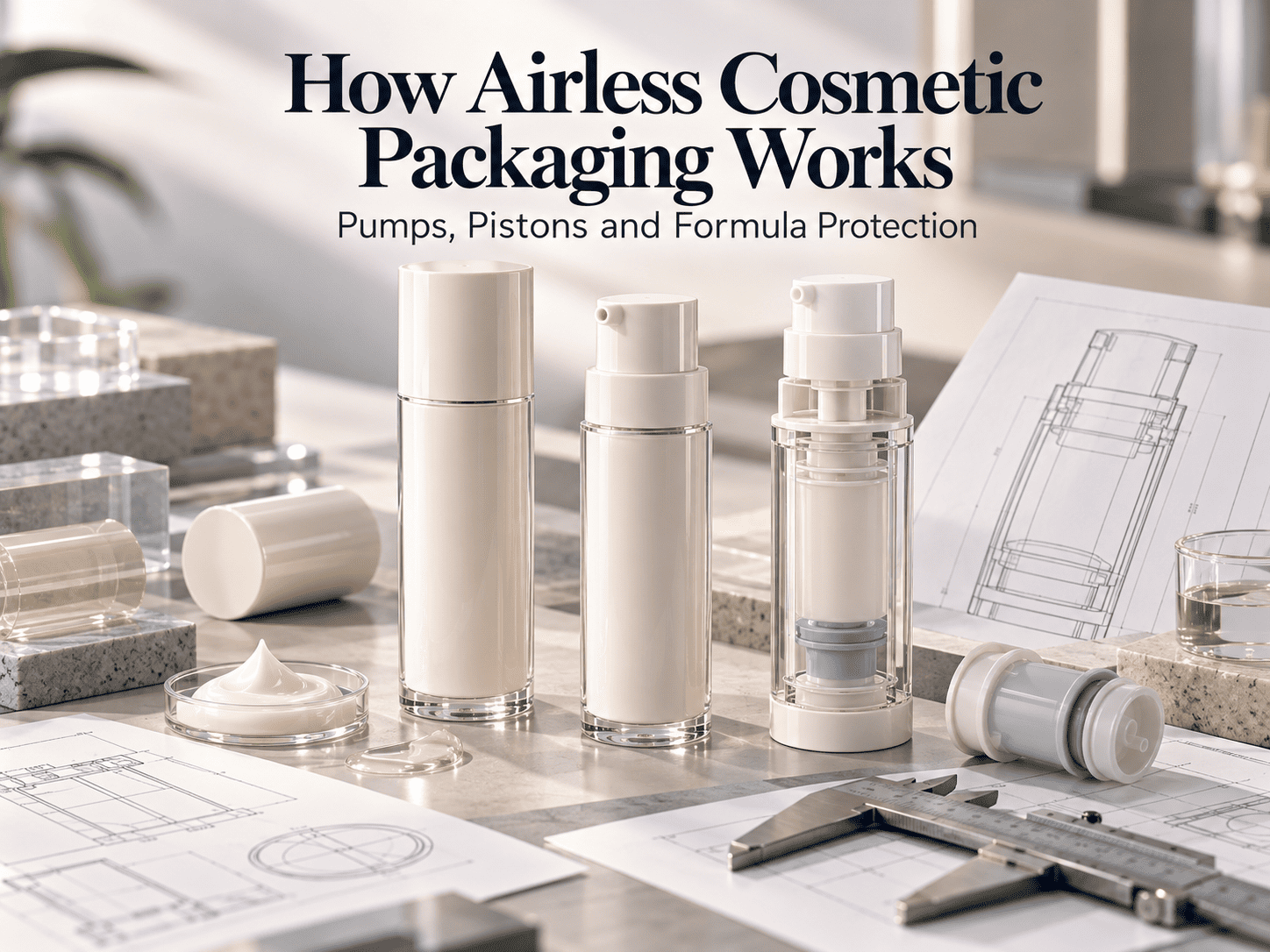
An airless package is a dispensing system in which the pump, piston or flexible inner container, actuator, seals and formula must work together. The system needs to prime correctly, deliver a controlled dose and evacuate the product while maintaining reliable sealing throughout its intended use.
For skincare brands, understanding these interactions is more important than simply choosing an airless bottle because it looks premium.
A beautifully designed package may still perform poorly if the formula is too viscous, the filling process traps excessive air, the pump output is unsuitable or the piston does not move consistently.
The right question is therefore not:
“Do we need an airless bottle?”
It is:
“Which airless system works with this formula, filling process and consumer-use requirement?”
What Is Airless Cosmetic Packaging?
In a conventional lotion pump bottle, a dip tube extends into the product. When the pump is activated, the formula is drawn upward through the tube while air enters the bottle to replace the dispensed volume.
A common piston-style airless bottle works differently.
There is typically no traditional dip tube. The formula sits above a moving piston at the bottom of the product chamber. As product is dispensed, the pressure difference created by the pump allows the piston to move upward, reducing the internal volume as the formula is used.
Other airless systems may use flexible pouches or bags rather than a rigid piston, but the objective is similar: dispense product without repeatedly replacing the removed volume with ambient air inside the main formula chamber.
This can reduce repeated direct exposure of the bulk product to external air during dispensing. However, “airless” should not be interpreted as meaning that the package contains absolutely no air or that oxidation is impossible.
Packaging performance still depends on the formula, filling method, seals, materials and complete package design.
Her Beauty currently offers airless packaging in multiple formats and capacities for skincare development. Explore Her Beauty Airless Bottle Packaging
How the Piston Airless System Works
A typical piston airless system can be understood in four stages.
1. Filling
The product is filled into the bottle chamber according to the structure and filling requirements of the package.
Correct filling is important because excessive trapped air, incorrect fill height or an unsuitable filling method may affect initial dispensing behaviour.
2. Priming
When the consumer first presses the actuator, several strokes may be required before product reaches the outlet.
This is known as priming.
The exact number of priming strokes depends on factors such as:
- Pump chamber volume
- Internal flow path
- Formula viscosity
- Fill level
- Package geometry
- Air trapped in the dispensing path
A high number of priming strokes can make the package appear defective even when the system eventually works.
Priming should therefore be evaluated before mass production.
3. Controlled Dispensing
Once primed, each actuator stroke should deliver a reasonably consistent amount of formula.
Pump output matters because the correct dosage depends on the product.
A facial serum may require a smaller controlled dose, while a body lotion may need higher output per stroke.
Too little output can frustrate the consumer. Too much may create waste or make dosage claims difficult to support.
4. Piston Movement and Evacuation
As formula leaves the package, the piston gradually moves upward.
Ideally, it follows the product consistently without sticking, tilting or leaving excessive formula behind.
The percentage of usable product removed from the package is often discussed as evacuation performance.
Good evacuation is valuable because consumers expect to access most of the formula they purchased.
Formula Viscosity Matters
One of the most important variables in airless cosmetic packaging is formula viscosity.
A light serum, lotion, thick cream and sunscreen do not move through the same pump system in the same way.
A lower-viscosity formula may flow easily but place greater demands on sealing and valve control.
A thicker formula may require:
- A larger flow path
- Different pump output
- More force during priming
- Appropriate actuator geometry
- Careful filling conditions
The challenge is not simply whether the pump can dispense the formula once.
Brands should evaluate whether it continues dispensing consistently throughout the package life.
Formula behaviour may also change with temperature.
A product that dispenses smoothly at room temperature may become noticeably thicker under cooler conditions. Conversely, higher temperatures may reduce viscosity and reveal leakage risks that were not obvious during initial evaluation.
For this reason, airless package selection should be coordinated with formula development rather than completed independently.
Airless Packaging Does Not Replace Compatibility Testing
An airless system can reduce certain forms of environmental exposure, but it cannot compensate for incompatible materials.
The formula remains in prolonged contact with the bottle chamber, piston, pump components, seals and other product-contact materials.
Possible interactions may include:
- Swelling
- Stress cracking
- Softening
- Discoloration
- Seal changes
- Formula migration
- Odour changes
- Changes in viscosity
Cosmetics Europe notes that packaging can directly influence finished-product stability through interactions between the formula and container, as well as through the barrier properties of the package. It recommends stability studies using packaging as close as possible to the final commercial pack.
Her Beauty has a separate guide covering these risks in more detail. Read Cosmetic Packaging Compatibility Testing
What Should Brands Test in an Airless Bottle?
Airless packaging should be evaluated as a complete system.
Priming
Record how many actuator strokes are required before the first proper dose is delivered.
Large variation between samples can indicate filling or system-control issues.
Pump Output
Measure the amount dispensed per stroke and confirm whether it remains sufficiently consistent through different stages of use.
Actuator Return
The actuator should return properly after each stroke.
Slow or incomplete return may indicate formula, valve or pump-performance issues.
Piston Travel
For piston systems, inspect whether the piston rises evenly and remains correctly positioned.
Tilting or sticking can interfere with product evacuation.
Evacuation
Determine how much usable formula remains when the package stops dispensing.
A visually attractive airless package that leaves a significant quantity trapped inside may produce poor consumer satisfaction.
Leakage and Seal Integrity
Evaluate the filled package under relevant storage and transportation conditions.
Orientation, temperature and formula exposure can all influence sealing performance.
Compatibility
Inspect both formula and packaging over the planned testing period.
Cosmetics Europe advises that stability testing can include different temperatures and package orientations, such as upright, inverted or on the side, depending on the product and test objective.
Common Airless Packaging Problems
The Pump Does Not Dispense Immediately
This may simply be a priming issue.
However, excessive priming strokes can also result from trapped air, inappropriate filling, high formula viscosity or an unsuitable dispensing path.
The Pump Stops Before the Bottle Is Empty
Possible causes may include poor piston movement, formula bridging, an unsuitable pump/formula combination or loss of system integrity.
The Piston Tilts
Piston geometry, bottle dimensions, friction and filling conditions may all influence movement.
Production tolerances should therefore be evaluated using representative moulded components.
Product Remains Around the Bottom or Walls
Some residue is normal, but excessive remaining product can indicate weak evacuation performance.
The brand should define an acceptable target during development rather than judging it only after launch.
Output Changes During Use
A pump that delivers a good dose at the beginning but becomes inconsistent later may not be properly matched to the formula.
Repeated-cycle testing is more informative than testing only the first few strokes.
Refillable Airless Packaging
Refillable airless systems are increasingly considered when brands want to retain a durable outer package while replacing only the formula-containing inner component.
A typical concept may include:
Permanent outer shell + replaceable airless cartridge
The engineering challenge is to ensure that refillability does not compromise dispensing or sealing.
Brands should evaluate:
- Cartridge installation
- Connection to the actuator
- Secure locking
- Removal force
- Consumer usability
- Leakage
- Repeat-use durability
- Material separation
A refill system only delivers its intended material-efficiency benefit if consumers actually retain and reuse the permanent outer component.
Her Beauty currently develops reusable outer structures combined with recyclable PP/PET inner systems as part of its sustainable packaging portfolio. Explore Her Beauty Sustainable Packaging Solutions
Mono-Material and Metal-Free Airless Systems
Traditional pumps may combine several plastics, elastomers and metal springs.
This creates challenges when brands want to simplify material composition.
Newer structures increasingly explore predominantly mono-material or metal-free dispensing systems.
Her Beauty’s existing mono-material portfolio includes PP- and PE-based airless concepts and metal-free pump directions intended to reduce material complexity. Read the Mono-Material Cosmetic Packaging Guide
However, sustainability improvements should not be evaluated only by counting materials.
A simplified pump still needs to meet:
- Priming requirements
- Output consistency
- Seal performance
- Formula compatibility
- Mechanical durability
- Evacuation targets
Function should be validated before environmental claims are made.
For brands selling into Europe, material simplification, recyclability and packaging minimisation are also becoming increasingly relevant under the EU Packaging and Packaging Waste Regulation. Read Her Beauty’s PPWR Cosmetic Packaging Guide
Decoration Should Follow Engineering
Airless bottles can support a wide range of decoration, including:
- Spray coating
- Matte finishing
- UV gloss
- Soft-touch coating
- Metallization
- Gradient effects
- Frosting
Her Beauty’s current airless range offers these decoration directions across several stock structures.
But decoration should not be approved before the package structure is proven.
A beautiful coating does not solve poor pump output or weak piston travel.
The better sequence is:
Formula + structure → dispensing validation → compatibility → decoration → production approval
This helps prevent brands from investing in finished appearance samples before the underlying package performance has been confirmed.
When Is a Custom Airless Structure Necessary?
Stock airless bottles can be an efficient choice when the capacity, pump output and general architecture already suit the project.
A custom mould becomes more relevant when the brand requires:
- Unique proportions
- A proprietary actuator
- Custom refill architecture
- Different pump integration
- Special outer-shell design
- Specific ergonomic requirements
- Exclusive visual identity
For custom projects, prototype and T1 testing should focus on both appearance and the dispensing system.
Her Beauty’s custom-moulding workflow includes DFM review, rapid prototyping, precision tooling and T1 sample evaluation before mass production. Explore Custom Cosmetic Packaging Development
A Practical Airless Packaging Checklist
Before approving an airless package, brands should confirm:
- Is the formula viscosity suitable for the selected pump?
- How many strokes are required to prime?
- Is the dose per stroke appropriate?
- Does output remain consistent through use?
- Does the piston travel smoothly?
- Is product evacuation acceptable?
- Has leakage been tested with the actual formula?
- Has compatibility been evaluated?
- Does the package perform under relevant temperatures?
- Is decoration stable on the final production material?
- If refillable, does the cartridge remain secure after repeated replacement?
The answers should come from representative physical testing rather than appearance alone.
Frequently Asked Questions
Does airless packaging completely prevent oxidation?
No. Airless packaging can reduce repeated exchange between ambient air and the bulk formula during dispensing, but performance depends on the complete structure, filling process, materials and seals.
Are airless bottles suitable for thick creams?
Many can be, but the pump, flow path and formula viscosity must be evaluated together. A package that works well with a serum may not perform the same way with a dense cream.
Why does an airless bottle need several pumps before product appears?
The dispensing path initially contains air. Priming strokes remove that air and draw product into the pump chamber.
Does an airless bottle always use a piston?
No. Piston systems are common, but airless designs can also use flexible inner bags or pouches depending on the package architecture.
Should the final formula be tested in the airless package?
Yes. Packaging and formula can influence each other over time, so representative final packaging should be included in stability and compatibility evaluation.
Develop Airless Packaging as a Complete System
Successful airless cosmetic packaging is not defined by the bottle alone.
The formula determines how the product flows.
The pump controls the dose.
The piston or inner system manages product movement.
The seals maintain package integrity.
The filling process affects priming.
And the material structure influences compatibility, recyclability and decoration.
When those elements are developed together, an airless package can provide controlled dispensing, good product evacuation and a premium user experience.
Her Beauty supports stock and custom airless packaging development across material selection, pump evaluation, private moulding, decoration, compatibility coordination and mass production.