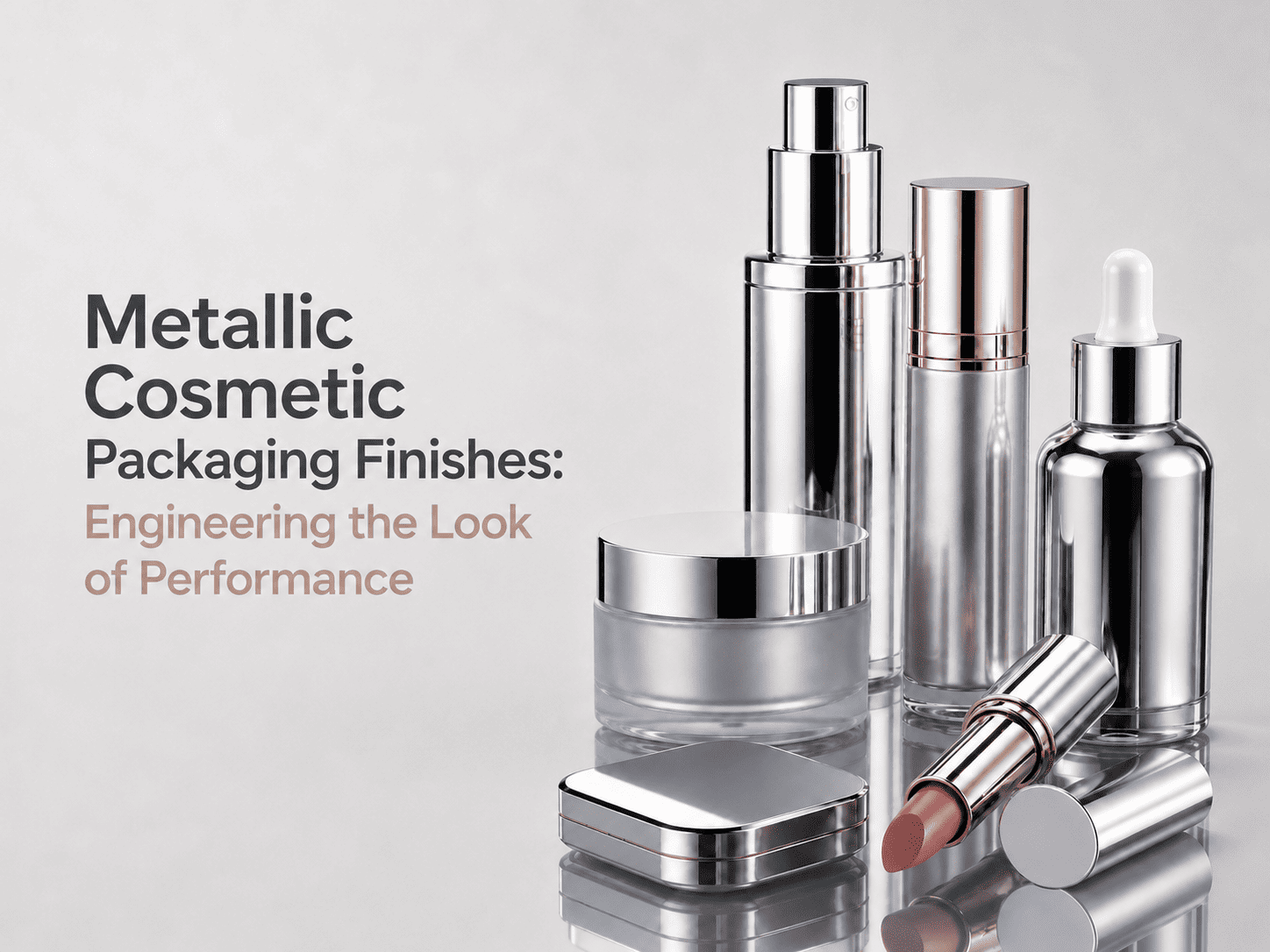
Metallic cosmetic packaging finishes are no longer used only to make beauty products look luxurious.
Chrome, satin silver, brushed aluminium, pearl coatings and liquid-metal effects are increasingly used to communicate technology, precision and product performance. Before consumers read a claim or try a formula, these surfaces can make skincare and makeup products feel more advanced and carefully engineered.
This represents a shift in the meaning of premium packaging.
Traditional metallic decoration often relied on ornamental gold and visual weight. Today’s metallic aesthetic is cleaner, lighter and more technical. It borrows visual codes from medical devices, consumer electronics and professional equipment, replacing decorative excess with controlled reflections, refined geometry and accurate component alignment.
However, a metallic finish becomes convincing only when the package beneath it is equally precise.
Reflective surfaces expose mould marks, uneven gaps, scratches and coating defects more clearly than many matte finishes. Successful metallic cosmetic packaging therefore depends on coordinated decisions across material selection, mould development, decoration, assembly and quality control.
Why Metallic Finishes Communicate Performance
Every packaging surface creates a different expectation.
Soft-touch coatings can suggest comfort. Frosted packaging is often associated with purity, while transparent packaging can communicate formula visibility and clarity.
Metallic finishes speak a different visual language.
Mirror chrome may evoke advanced technology. Satin silver can feel clean and dependable. Brushed aluminium suggests professional equipment, while pearl metallic coatings introduce a softer interpretation of scientific beauty.
These effects are particularly relevant to products positioned around:
- Clinical skincare
- Sun protection
- Skin repair
- Advanced active ingredients
- Precision application
- Professional makeup
- Beauty technology
- High-performance formulas
Packaging does not prove that a formula works. It can, however, influence the consumer’s expectations before the product is used.
The effect comes from more than colour. The way light moves across a metallic surface reveals the shape of the package and creates changing highlights as the consumer handles it. This makes the product feel dynamic without depending on bright graphics or excessive decoration.
Metallic Finish Versus Metal Packaging
Metallic packaging and metal packaging are related but not identical.
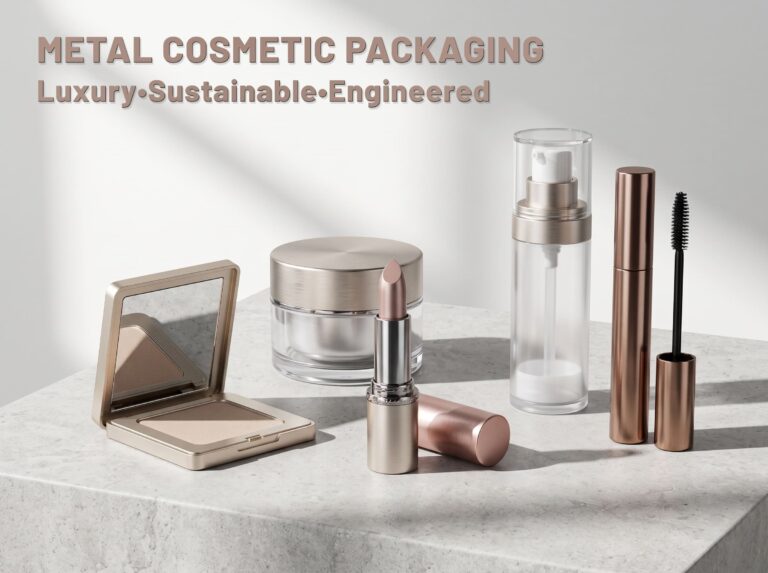
Metal packaging uses actual metal components, such as aluminium shells, caps, sleeves or compact pans.
A metallic finish creates a metal-like appearance on another substrate, which is often plastic. This can be achieved through vacuum metallization, spray coating, hot stamping or metallic pigments.
The two approaches differ in:
- Weight
- Touch
- Shape flexibility
- Structural performance
- Decoration options
- Cost
- Production process
- End-of-life considerations
Real aluminium provides a cool touch and authentic metal surface. Metallized plastic offers greater freedom for lightweight shapes and complex components.
The right option depends on the intended appearance, package function, target quantity and sustainability objectives.
For a broader discussion of real aluminium structures and metal components, read Her Beauty’s guide to metal cosmetic packaging.
Main Types of Metallic Cosmetic Packaging Finishes
Vacuum Metallization
Vacuum metallization is widely used to create reflective effects on suitable plastic components.
A thin metallic layer is deposited onto the prepared substrate and normally protected by a top coating. Additional colour layers can create silver, gold, rose gold, champagne or coloured chrome effects.
Common applications include:
- Lipstick tubes
- Lip gloss and mascara caps
- Compact cases
- Pump collars
- Skincare closures
- Decorative outer shells
Vacuum metallization provides strong reflectivity without requiring the entire component to be made from metal.
Its quality depends heavily on the moulded substrate. Flow lines, scratches, dust and uneven surfaces may remain visible or become more noticeable after metallization.
Mirror effects therefore require excellent mould condition, clean components and controlled handling.
Metallic Spray Coating
Metallic spray coating creates a wider range of textures and gloss levels.
Possible effects include satin silver, pearl finishes, soft champagne, gunmetal and coloured metallic gradients. Compared with mirror chrome, sprayed finishes can feel softer and less industrial.
This makes them suitable for skincare and personal-care products that need to balance technology with warmth.
The final result depends on coating thickness, metallic particle distribution, curing conditions and component geometry. A coating may appear different on a flat cap, narrow lipstick tube and curved skincare bottle.
For this reason, brands should approve the finish on the actual component rather than relying only on a flat colour chip.
Aluminium Components
Real aluminium creates a distinctive sensory experience through its cool touch, rigid structure and authentic surface.
It is frequently used for lipstick tubes, compact cases, mascara packaging, fragrance components and premium skincare closures.
Aluminium can be polished, brushed, anodized, lacquered or laser engraved. It may also be combined with plastic inner mechanisms where sealing, movement or formula compatibility requires another material.
The connection between metal and plastic components must be carefully engineered. Poor tolerances can cause loose assembly, visible gaps or inconsistent operation.
For projects involving custom structures, Her Beauty’s private mould development service supports feasibility review, prototyping, tooling and off-tool sample evaluation.
Hot Stamping and Metallic Accents
Not every package needs a full metallic surface.
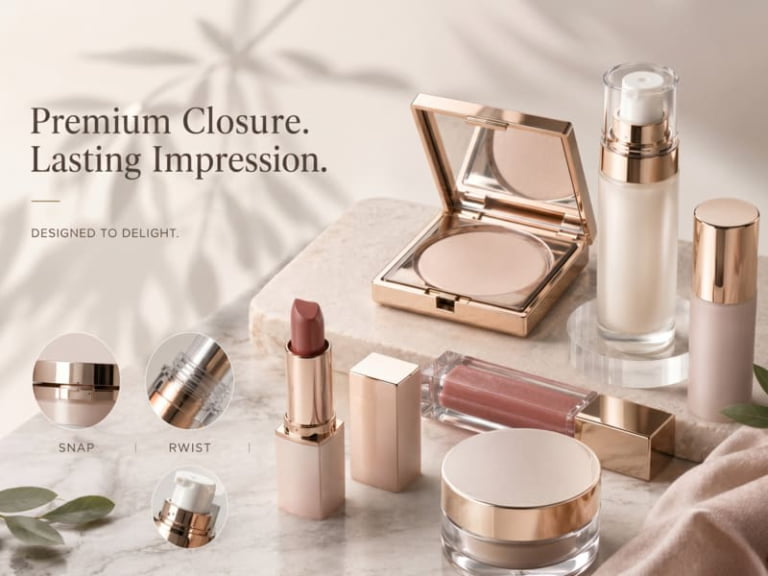
Hot stamping can add precise metallic logos, lines or decorative bands while preserving the original colour and material of the package.
A limited metallic accent can provide strong shelf impact with less visual complexity than full-body decoration.
This approach is effective for:
- Matte lipstick tubes
- Compact cases
- Skincare caps
- Gift packaging
- Coordinated product collections
The foil, substrate and stamping parameters must be tested together to achieve clean edges and consistent adhesion.
Why Metallic Surfaces Require Better Engineering
Metallic finishes make packaging details easier to see.
As light moves across the surface, it can reveal:
- Mould flow marks
- Parting lines
- Uneven gloss
- Dust beneath the coating
- Scratches
- Inconsistent colour
- Irregular masking edges
- Poor component alignment
- Uneven gaps between the cap and container
A metallic coating cannot hide weak packaging engineering. In many cases, it amplifies it.
The finish should therefore be considered before the mould and structure are finalised.
Parting lines may need to be moved away from highly visible areas. Assembly contact points should be reviewed to prevent decorated surfaces from rubbing against each other. Protective trays or films may be required during handling and transportation.
The earlier these details are evaluated, the easier it is to reproduce the intended appearance during mass production.
From Approved Sample to Mass Production
A successful studio sample does not automatically guarantee stable production.
Metallic cosmetic packaging finishes can change according to the production batch, substrate condition, coating thickness, equipment settings and viewing environment.
Before mass production, brands and suppliers should agree on a physical approval standard covering:
- Metallic colour
- Gloss level
- Reflection intensity
- Surface texture
- Coverage
- Masking boundaries
- Acceptable visual variation
- Logo and printing appearance
When several components form one package, colour coordination is especially important.
The same silver may appear different on plastic, aluminium and glass. Even two plastic parts can vary because of resin type, wall thickness or mould texture.
The goal is not always perfect numerical colour identity. It is controlled visual consistency across the complete package.
For a coordinated makeup range, brands can explore Her Beauty’s custom lipstick tube packaging and broader makeup packaging solutions.
Protecting the Finish During Assembly
A decorated component may pass inspection and still become damaged during assembly.
Fixtures, conveyors, operator handling and contact between components can create scratches or pressure marks. Mirror chrome and dark metallic finishes are particularly sensitive.
Assembly planning may require:
- Protective films
- Soft-contact fixtures
- Separation between decorated parts
- Adjusted assembly pressure
- Reduced friction between moving components
- Individual packaging protection
Function must also be evaluated together with appearance.
A lipstick should twist smoothly. A compact must open and close correctly. A pump needs consistent dosage, while a bottle and closure must remain secure during transportation.
Depending on the project, quality evaluation may include visual inspection, dimensional checks, functional cycling, coating adhesion review, leakage testing and transportation assessment.
Choosing the Right Metallic Direction
Different metallic effects support different brand identities.
Mirror Chrome
Mirror chrome creates a strong futuristic and technical impression. It is suitable for high-performance skincare, beauty-device-inspired products and precision makeup.
Because it is highly reflective, the underlying component and coating consistency must be carefully controlled.
Satin Silver
Satin silver feels cleaner and quieter than mirror chrome. It can communicate professional quality without becoming overly cold or reflective.
It works well for skincare, suncare and clinical-inspired products.
Brushed Aluminium
Brushed aluminium creates a tactile and engineered appearance. The directional texture controls strong reflections while maintaining authentic metal character.
It is suitable for premium lipstick tubes, professional makeup and refillable outer cases.
Pearl Metallic
Pearl finishes combine technical cues with a softer beauty aesthetic.
They are effective for hydration, brightening, complexion and personal-care products that need to feel innovative but approachable.
Coloured Metallic Finishes
Blue, green, violet, champagne and graphite metallic finishes can combine technical positioning with stronger brand recognition.
Colour, gloss, package geometry and printed graphics should be developed together. When the metallic effect is visually strong, reducing other decoration often produces a cleaner result.
Metallic Finishes and Sustainability
A metallic appearance should be evaluated as part of the complete packaging system.
Real aluminium, metallized plastic, spray coatings and hot-stamped accents have different implications for weight, material separation, durability and recyclability.
There is no single solution that is automatically more sustainable for every product.
Brands should consider:
- Total package weight
- Number of materials
- Ability to separate components
- Decoration coverage
- Recycled-content options
- Refillability
- Intended product life
- Transportation efficiency
- Target recycling infrastructure
For some projects, a durable aluminium outer case with a lightweight refill may support repeated use. For others, a lightweight plastic package with limited metallic decoration may be more practical.
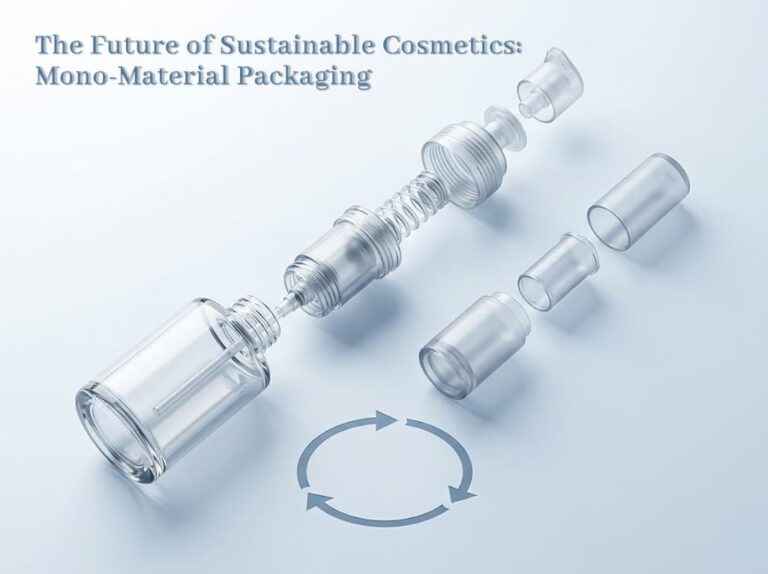
Her Beauty’s sustainable packaging solutions include PCR materials, mono-material structures, refillable systems and reduced-material concepts.
The final decision should balance visual identity with product protection, production stability and end-of-life considerations.
Frequently Asked Questions
What is the difference between vacuum metallization and aluminium packaging?
Vacuum metallization applies a thin metallic layer to a suitable substrate, often plastic. Aluminium packaging uses an actual metal component. They differ in touch, weight, shape flexibility, production cost and structural performance.
Which cosmetic products are suitable for metallic finishes?
Metallic effects are commonly used for lipstick tubes, lip gloss caps, mascara packaging, compact cases, airless bottles, cream jar lids, pump collars and skincare closures.
Can metallic colours be customized?
Yes. Brands can customize the colour, gloss, texture, coverage and combination of metallic effects. Physical samples should be approved because geometry and lighting affect the final appearance.
How can scratching be reduced?
Scratching can be reduced through appropriate coating selection, component tolerances, protective handling, improved assembly fixtures and packaging that prevents decorated surfaces from contacting each other.
Develop Metallic Cosmetic Packaging with Her Beauty
Metallic finishes can help cosmetic packaging communicate precision, innovation and performance.
The effect becomes convincing only when the substrate, mould quality, decoration and user experience support the same message.
Her Beauty works with beauty brands, filling factories and distributors on metallic cosmetic packaging development, including:
- Material and structure evaluation
- Private mould development
- Injection and blow moulding
- Vacuum metallization
- Spray coating
- Hot stamping
- Silk-screen printing
- Assembly
- Visual and functional inspection
Whether you are developing a chrome lipstick tube, satin compact case, aluminium skincare closure or coordinated beauty collection, our team can help evaluate a production-ready solution.
Send Her Beauty your packaging type, reference images, target finish, expected quantity and launch schedule.
Contact Her Beauty to discuss your metallic cosmetic packaging project.
The finish should not only look precise. It should be produced precisely.