Across North America and Latin America, the beauty sector is undergoing a noticeable shift toward products designed for mobility and lifestyle integration. One emerging category—wearable cosmetic packaging—is gaining traction by turning everyday items like lipstick or sunscreen into accessories that can be carried as easily as jewelry. By incorporating elements such as chains, lanyards, or clip-on features, brands are redefining how consumers interact with beauty products in daily life.
At Her Beauty Solution, this concept is approached not just as a design trend, but as a supply chain opportunity. Standard packaging formats can be re-engineered into functional, fashion-oriented items through integrated development, enabling brands to move beyond conventional product presentation.
Rethinking Value: Why Wearable Packaging Appeals to Brands
The growing interest in wearable formats is closely tied to changing consumer expectations and broader global packaging trends, where functionality and user experience are becoming key purchasing drivers. Convenience alone is no longer sufficient; products are expected to fit seamlessly into a broader lifestyle. For brand owners, this shift creates several practical advantages.
Products that double as accessories naturally increase visibility. When worn as a necklace or attached to a handbag, the packaging itself becomes a form of passive brand exposure. This visibility can extend far beyond traditional usage moments.
There is also a pricing implication. Packaging that combines utility with aesthetic appeal often supports a higher perceived value. In many cases, consumers are willing to pay more for items that resemble fashion accessories rather than standard containers.
Demographically, the concept resonates strongly with younger audiences. Consumers in Gen Z and Gen Alpha segments tend to prioritize portability, personalization, and visual appeal. Wearable packaging aligns with these preferences by offering both function and self-expression.
Engineering Considerations Behind Wearable Formats
While the idea may appear design-driven, execution depends heavily on structural reliability. Simply attaching a chain to an existing container is rarely sufficient. Movement, friction, and repeated handling introduce stress points that must be addressed through engineering.
One critical area is the attachment mechanism. Instead of relying on add-on components, more durable solutions involve integrating hooks or loops directly into the mold design. This approach reduces the risk of detachment and ensures the packaging can withstand regular use. Material selection also plays a role. Lightweight plastics such as PP or PET are often used for cost efficiency and recyclability, while PCR plastic in cosmetic packaging is increasingly adopted to meet sustainability expectations.
Another key factor is sealing performance. Because wearable products are exposed to constant motion, the risk of leakage becomes more significant. To mitigate this, leak-resistance testing—such as vacuum-based methods—is commonly applied to verify structural integrity. Closure systems can also be reinforced. For example, caps designed with stronger tactile feedback help ensure that the product remains securely sealed during wear.
Application Scenarios Across Product Categories
Wearable packaging is not limited to a single product type. Its adaptability allows it to be applied across multiple categories, each with slightly different functional requirements.
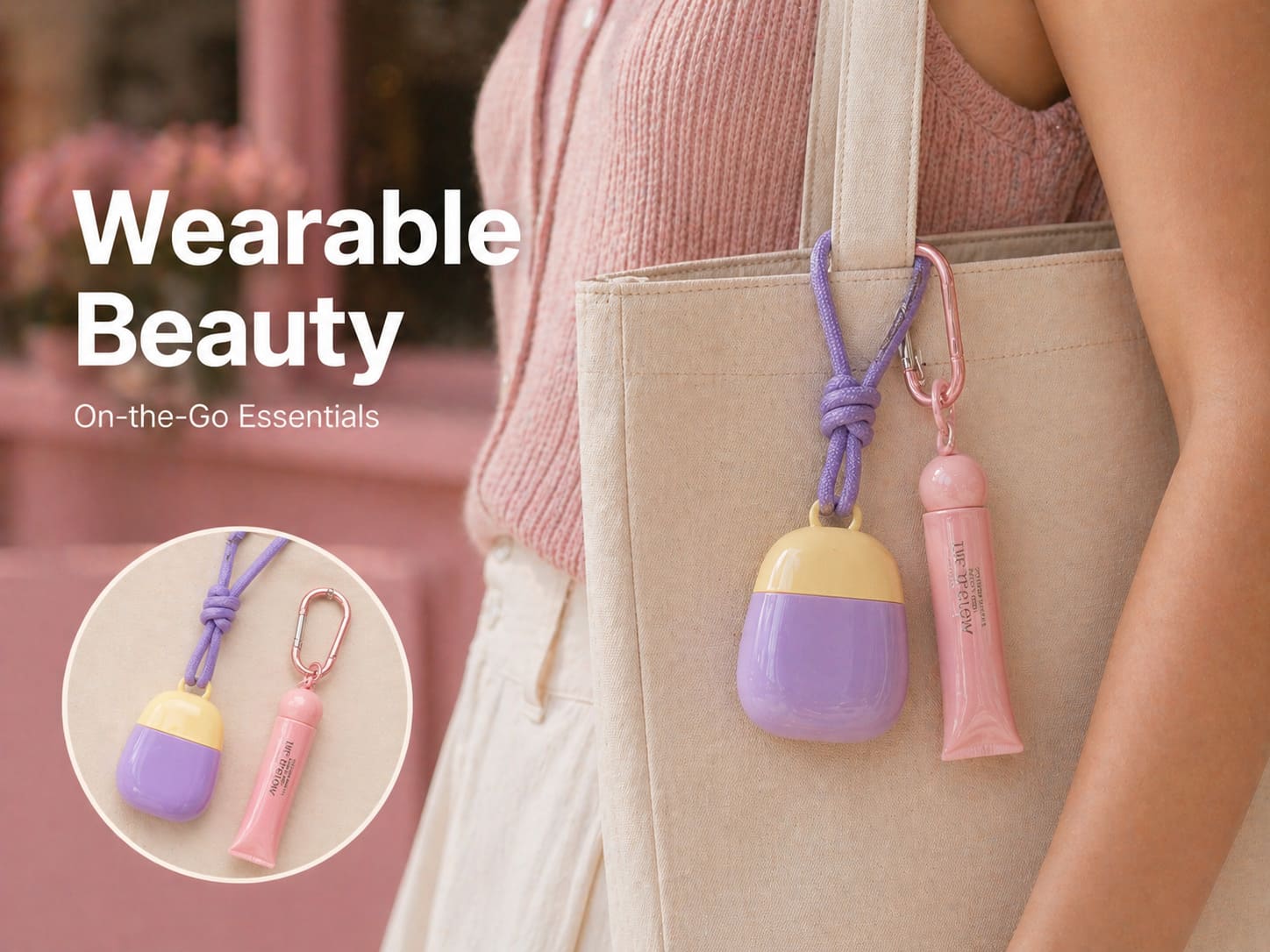
Lip products, such as gloss or oil, are often paired with clip-on mechanisms or decorative chains, balancing accessibility with visual appeal. Lipstick tubes may incorporate built-in rings or caps designed for attachment, maintaining a compact yet durable structure.
For skincare, mini sunscreen formats are particularly suitable. When paired with soft lanyards or neck cords, they offer quick reapplication without the need to search through a bag. Solid perfumes, on the other hand, can adopt a pendant-like form, emphasizing their dual role as fragrance and accessory.
Material choices typically vary depending on positioning. Transparent plastics like PETG are often used to highlight product clarity, while mono-material solutions or recyclable plastics may be prioritized for sustainability-focused lines. Metal components are more common in premium or jewelry-inspired designs.
Finishing Techniques: Elevating Perceived Value
To meet the expectations of higher-end markets, surface treatment becomes an essential part of the design process. Finishing is what ultimately bridges the gap between packaging and accessory.
Techniques such as UV plating can create a reflective, metallic appearance that resembles fine jewelry. Soft-touch coatings add a tactile dimension, making products feel more refined in hand. Meanwhile, precise silk screen printing ensures that branding remains intact even with frequent contact against skin or clothing.
These enhancements do not change the core function of the packaging, but they significantly influence how the product is perceived at retail and during use.
From Concept to Scale: Operational Considerations
For brands exploring wearable packaging, execution at scale requires more than design and engineering. Compliance and production efficiency remain central to successful market entry.
Material safety documentation, such as MSDS, is typically required to align with evolving global packaging regulations, particularly in Europe and North America. At the same time, manufacturing processes must be optimized to handle larger production volumes without compromising consistency.
Another practical consideration is component integration. Wearable packaging often involves multiple elements—containers, chains, straps, and connectors. Coordinating these parts into a single, ready-to-fill solution can simplify downstream operations for brands and their filling partners.
Looking Ahead
Wearable cosmetic packaging reflects a broader shift in how beauty products are positioned. Instead of being stored away, they are becoming visible, interactive, and integrated into daily routines. For brands, this opens up new ways to differentiate—not only through formulation, but through form and function.
Companies exploring this direction may benefit from approaching it as a cross-functional effort, combining design, engineering, and supply chain planning from the outset.